

“You will be haunted by three spirits,” cried Jacob Marley.
The old Victorian tale felt hauntingly relevant on a recent road trip to Ohio when Ghosts of Hermann Sons Past revealed vestiges of the organization’s former days, looked evocatively upon Today with all the hindsight of the intervening decades and world conflicts, and haply harbingered a future yet to come.
“Who are you?” asked Ebenezer Scrooge. “Ask me who I was,” replied the ghost.
Orden der Hermann Soene was formed in 1840 in New York and spread quickly throughout northern parts of the United States, and by 1848 a National Grand Lodge with offices was formed in New York City.
Hermann Sons got its foothold in Texas when two members of the New York lodge took up residence in San Antonio, a city thick with people of German descent. The two itinerant representatives assembled a number of German-speaking San Antonians on Christmas Day 1860 and “talked Hermann Sons.” By 1861 the first Texas lodge was founded in San Antonio. Many more Texas lodges followed.
From 1861 until 1920 the Texas lodges were united with hundreds of lodges across the country, nearly every state, under the umbrella of the National Order of the Sons of Hermann.
By 1913, Texas had gained more than one tenth of all membership of the national order. In 1921 the Texas Grand Lodge was financially stronger and had more members than all other lodges in the United States combined. You might say Texas seceded from the national order, forming its own Texas Grand Lodge, completely disambiguated from the national order.
By the 1930s, war-era anti-German sentiment took its toll on German-affiliated organizations nationwide; the Hermann Sons national order began to decay. By 1937 the count of lodges outside Texas dwindled to 138 in 10 states. That same year 371 lodges were operating in Texas independently, and membership had even managed to grow slightly during the war.
It was Brother Peter Kesdorf of Akron, Ohio who sought to reunify the national order, a last entreating effort in the waning years of its existence.
In 1946, Kesdorf took the helm of the crumbling national order, personally inspired by its enduring principles and motto. Soon into his first term President Kesdorf traveled to several eastern states in hopes of folding them back into the order, and even laid plans for a national grand lodge publication for sharing lodge news coast to coast.
Texas, too, was asked to rejoin. In the minutes of the national grand lodge meeting on August 1, 1948 Kesdorf reported that he received a letter from the Grand Present of Texas [Carl Biebers], wherein it was stated that the State of Texas would not consider membership in the national order.
Only 5 states were represented at the 1948 national grand lodge meeting: Ohio, Massachusetts, New York, Indiana, and California.
Despite the effort, Kesdorf did not see his mission succeed. According to Ohio lodge records, in 1952 “the Grand Lodge of Ohio turned the office of the National Organization back to California books and the remaining cash balance… and to this day [1956] we have not received any acknowledgment of same.” The once mighty national order was effectively dissolved by these actions.
“I hope and my sincere wish is that we unite again from East to West and live up to our Ancestors Name and Reputation,” said Peter Kesdorf.
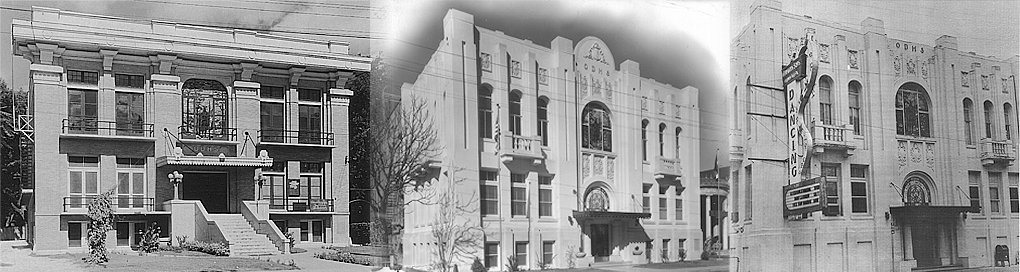
Meanwhile Ohio lodges carried on, continuing to this date the practices of their predecessors, and still hold the largest concentration of lodges outside of Texas. They still assemble biennially for a convention that rotates through the three halls located in Akron, Mansfield, and Massillon.
As if led by the Ghost of Hermann Sons Present, one Texas Hermann Sons member drifted into Akron, Ohio to attend the October 2024 state convention, hovering nigh as rituals and traditions were enacted, mirroring their origins and honoring a long standing Constitution. There, the Present played out in a parallel existence, merrily, faintly acknowledging its former kinship with brothers and sisters far and wide.
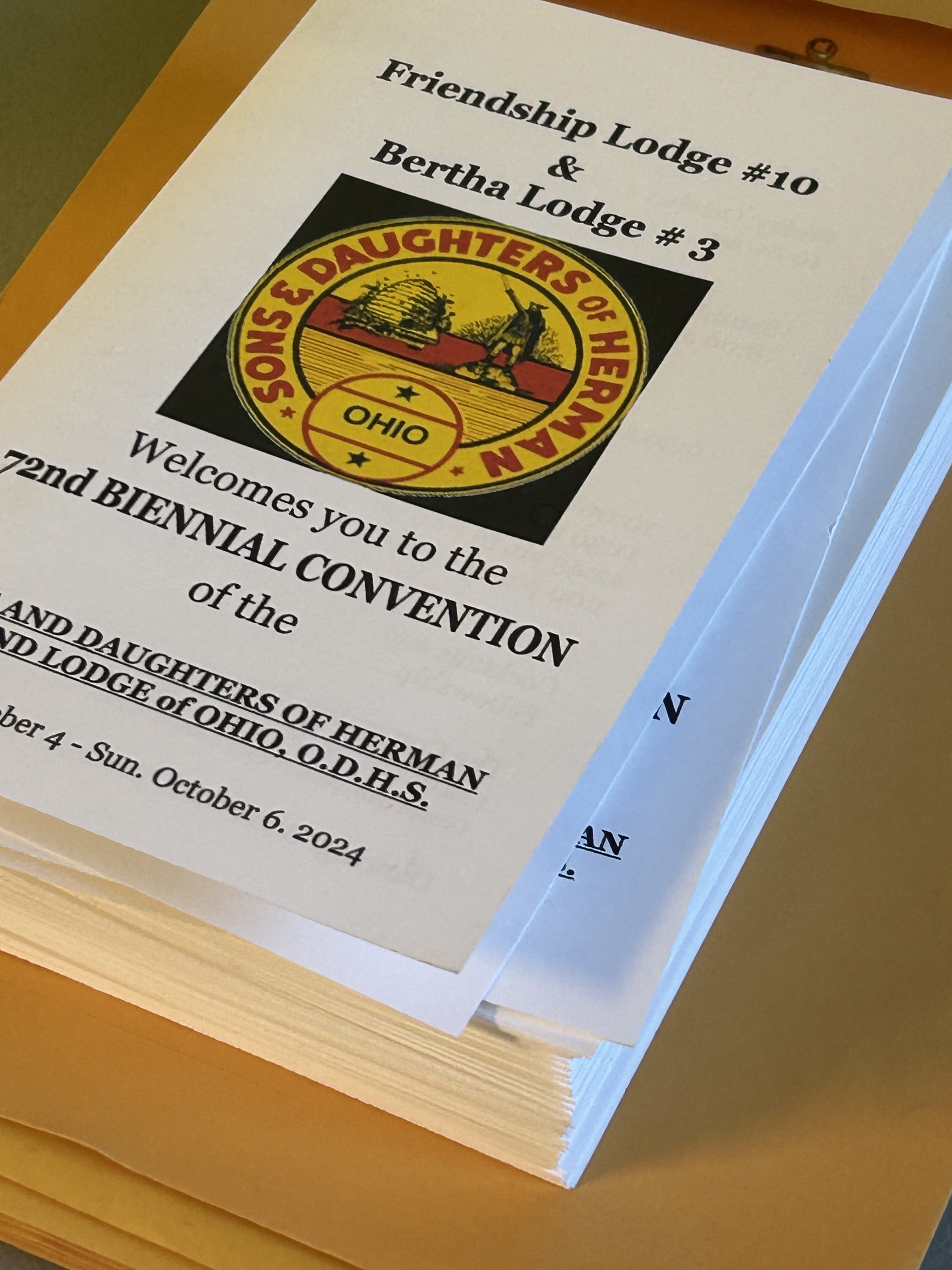
The Grand Lodge of Ohio October 2024 meeting was hosted by the Friendship and Bertha lodges of Akron (both established in 1914). The meeting was respectfully called to order by officers wearing matching navy blazers bearing the Ohio Sons of Herman logo, and modern regalia (badges) that resemble those worn a century ago, connecting present day members to their ancestors and past in an unbroken lineage of ceremonies. Even the secret salutations remain in use.
Though remarkably similar to Texas, the main difference is that membership in the Ohio Sons and Daughters of Herman is not derived from the purchase of an insurance policy from its licensed insurance company governed by state and federal agencies, as in Texas. Rather, the Ohio members lock in a $500 death benefit which is self-administered, self-funded by a portion of member dues. The family of a Sons of Herman member simply receives $500 upon the member’s death. This practice is in keeping with the 185-year-old intent of a mutual aid society, an uncomplicated, altruistic solution for the pre-insurance era where responsibilities were shared among neighbors. The remainder of dues money funds charitable causes and lodge activities.
Somewhere along the way the Ohioans dropped the 2nd N in Herman, which is curious to both the Texans and Ohioans, as we recognize that the original German spelling used nationally always contained both Ns.
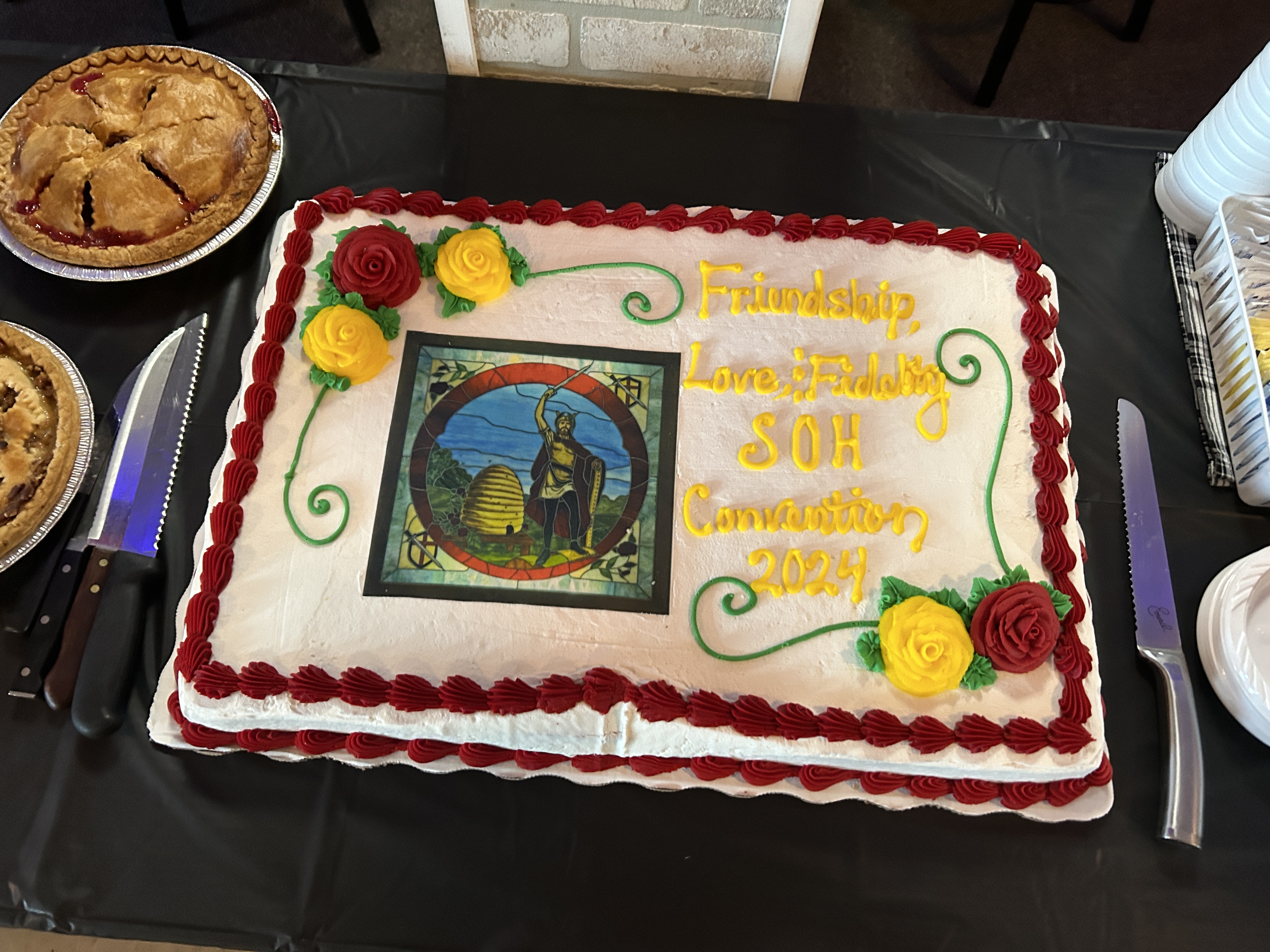
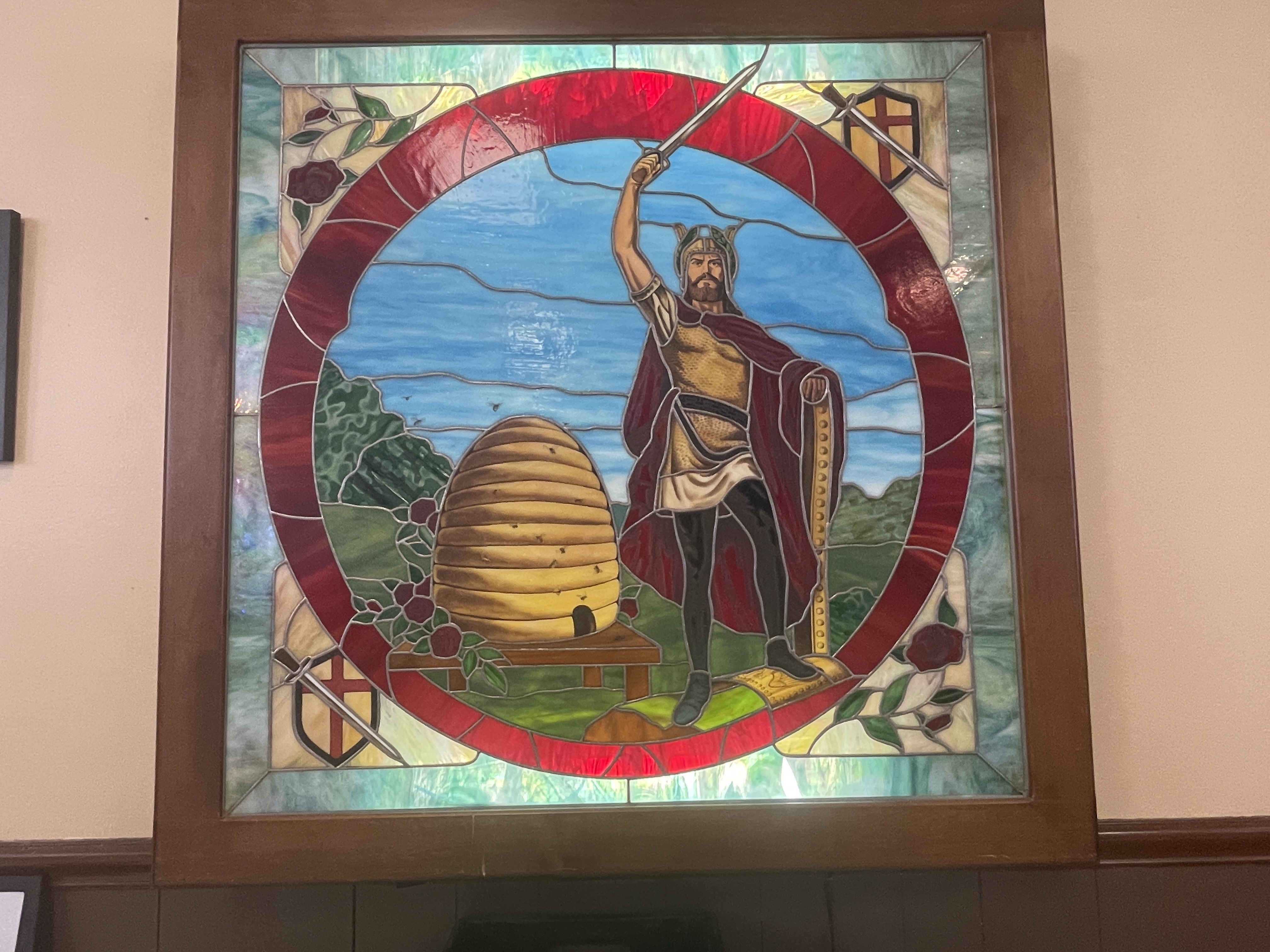
The Ohioans also felt compelled to include the “daughters’ in the name, at least dating back to the 1930s, as each lodge has a separate organization for brothers and sisters. The Ohio imagery often contains a beehive beside Hermann which is meant to symbolize domestic fidelity. A dead bee represents the dear sisters who have lost their life in the battle of existence. Roses and rosebuds, too, represent the women old and young.
The Ohioans and Texans are certainly united by their love of food and fun. As in Texas, rituals are accompanied by hearty meals, a couple rounds from the bar, and a dance band. Folks of all ages, who had solemnly conducted business earlier that day, cut loose that evening and shared the dance floor with the Texas interloper.
Perhaps brother Kesdorf was a harbinger of the future. Amidst the revelry a new resolve was formed — a desire to “unite again from East to West” — in the 21st century, at least in cyberspace, in hopes of outlasting the fleeting present, lest we finally lose all connectivity to each other and our shared past.

by Jennifer Stanford | posted December 12, 2024
All rights reserved.


Leave a comment