

It’s debatable whether you can consider Hermann Sons a secret society.
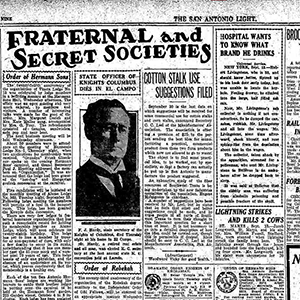
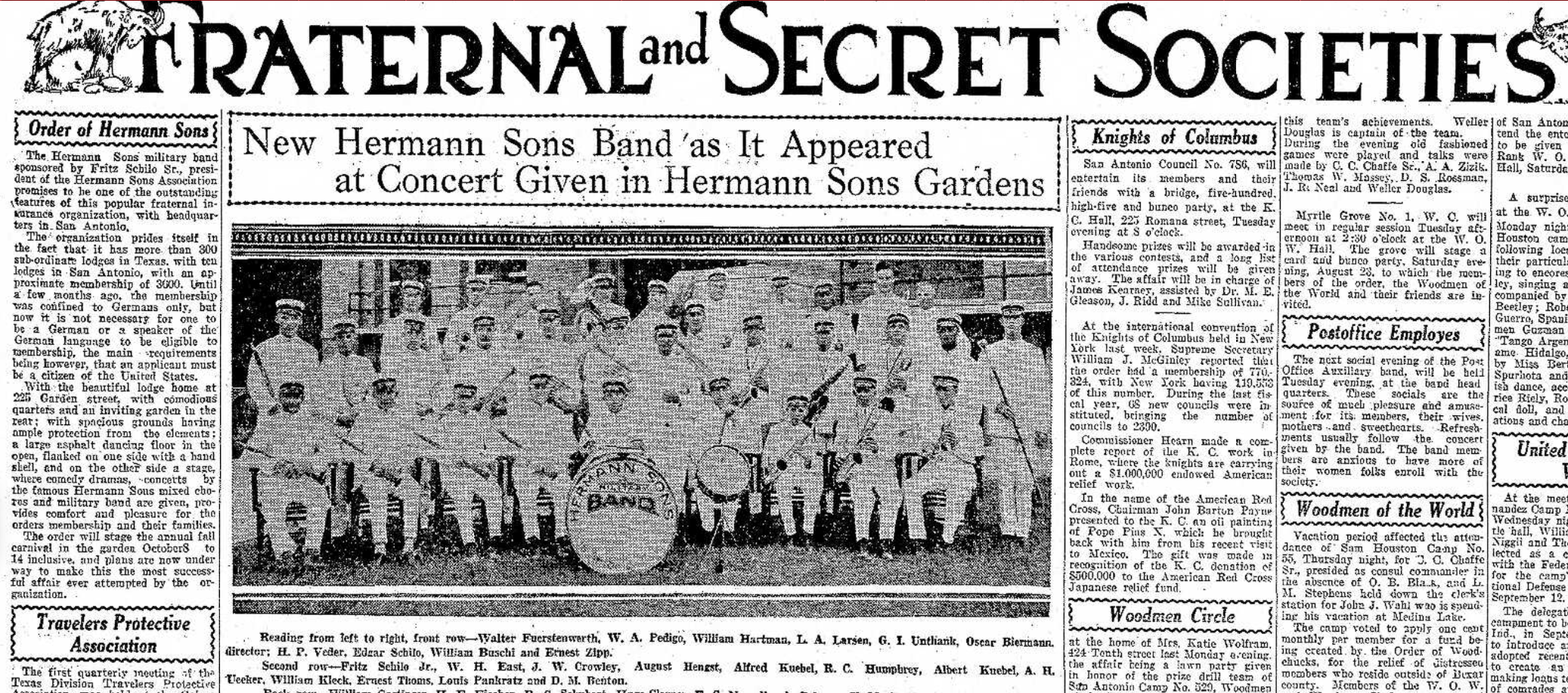
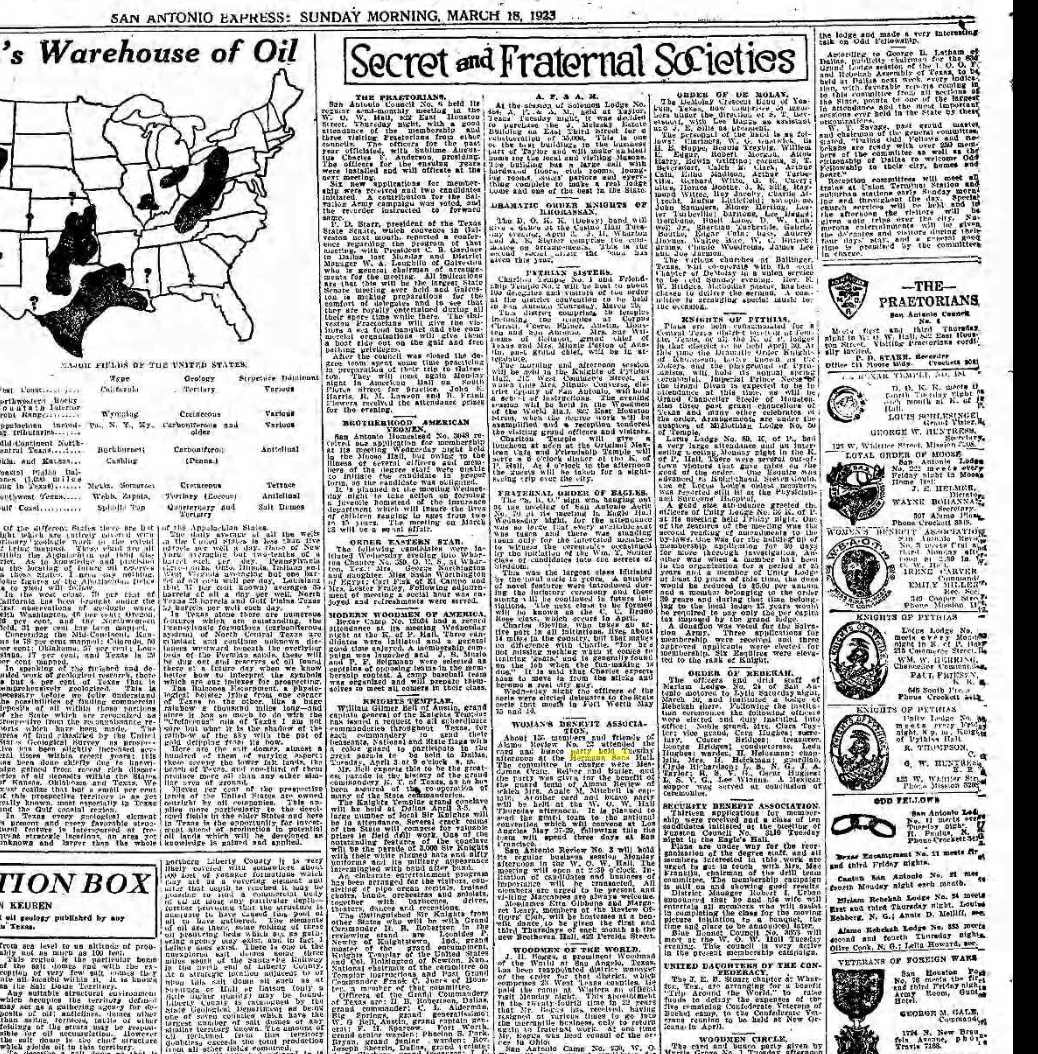
However, it is not uncommon to relate the rituals, initiations, oaths, and secret hand signs and passwords of fraternal orders to those of commonly recognized secret societies. The loosest definitions of a secret society describe an oath-bound organization often devoted to brotherhood, moral discipline, and mutual assistance, sharing secret passwords and rites – elements that have certainly applied to Hermann Sons throughout most of its existence. In fact, in the mid-1920s both the San Antonio Express and San Antonio Light newspapers had a dedicated section prominently named “Fraternal and Secret Societies” where the goings on of those societies were announced – at least the non-secret ones. Hermann Sons happenings could always be found on that page.
Secrets aside, Hermann Sons have always abided by rituals. The rituals were provided to members in the form of small books. Older editions were hardbound and gilt. Generally updated once per decade, the ritual book has changed over time, becoming more relaxed, but some customs are still acknowledged and followed at meetings today.
About 50 years ago, Hermann Sons rituals looked something like this:
- Flag ceremony – It was optional but recommended that lodge meetings open with a flag ceremony honoring both the American flag and the Texas flag. The Pledge of Allegiance was never optional.
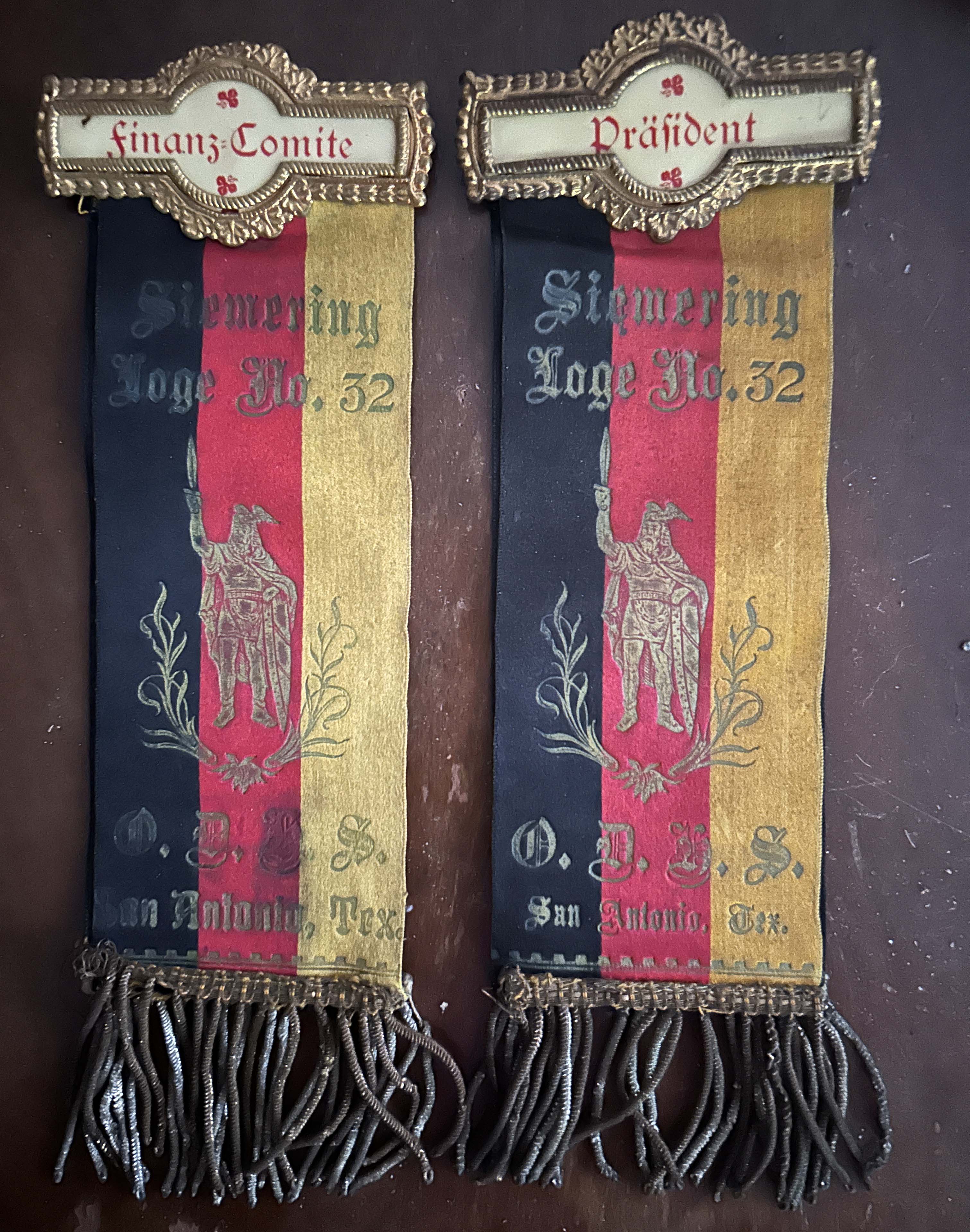
- Seating arrangements – Explicit directions were given. “The president shall be seated in the most prominent and practical position within the room. The Vice President shall be seated opposite the president. The Past President shall sit to the right of the President, mid-way between the President and Vice President. The Guide shall be seated opposite the Past President. The Outer Guard shall be placed near the door, either inside or outside as lodge business dictates…” and so on. Other positions such as Secretary and Finance Committee members had equally specific seating requirements.
Interestingly, the earliest Hermann Sons records reveal that chairs were not provided at meetings in the first years. Members were required to BYO chair if they cared to be seated.
- Charter – The lodge charter was to be prominently displayed at all lodge meetings, regular or special.
- Passwords – Among standard formalities when calling the meeting to order, the president asked the guide to “…convince yourself that all those assembled have the password and that they are entitled to participate in the session.” Any member who did not have the password should obtain the password from the president, and only the president, or a duly authorized representative. Passwords were confidential and only shared with full-fledged members.
- Meeting attendance – Requirements were fairly strict. A complete record of attendance was kept. The president was to ascertain that a quorum was met. Meetings were to start promptly on time, with officers positioned at their stations.
- Parliamentary procedures were followed.
Many members acquired this competence in their youth as Junior Hermann Sons members.
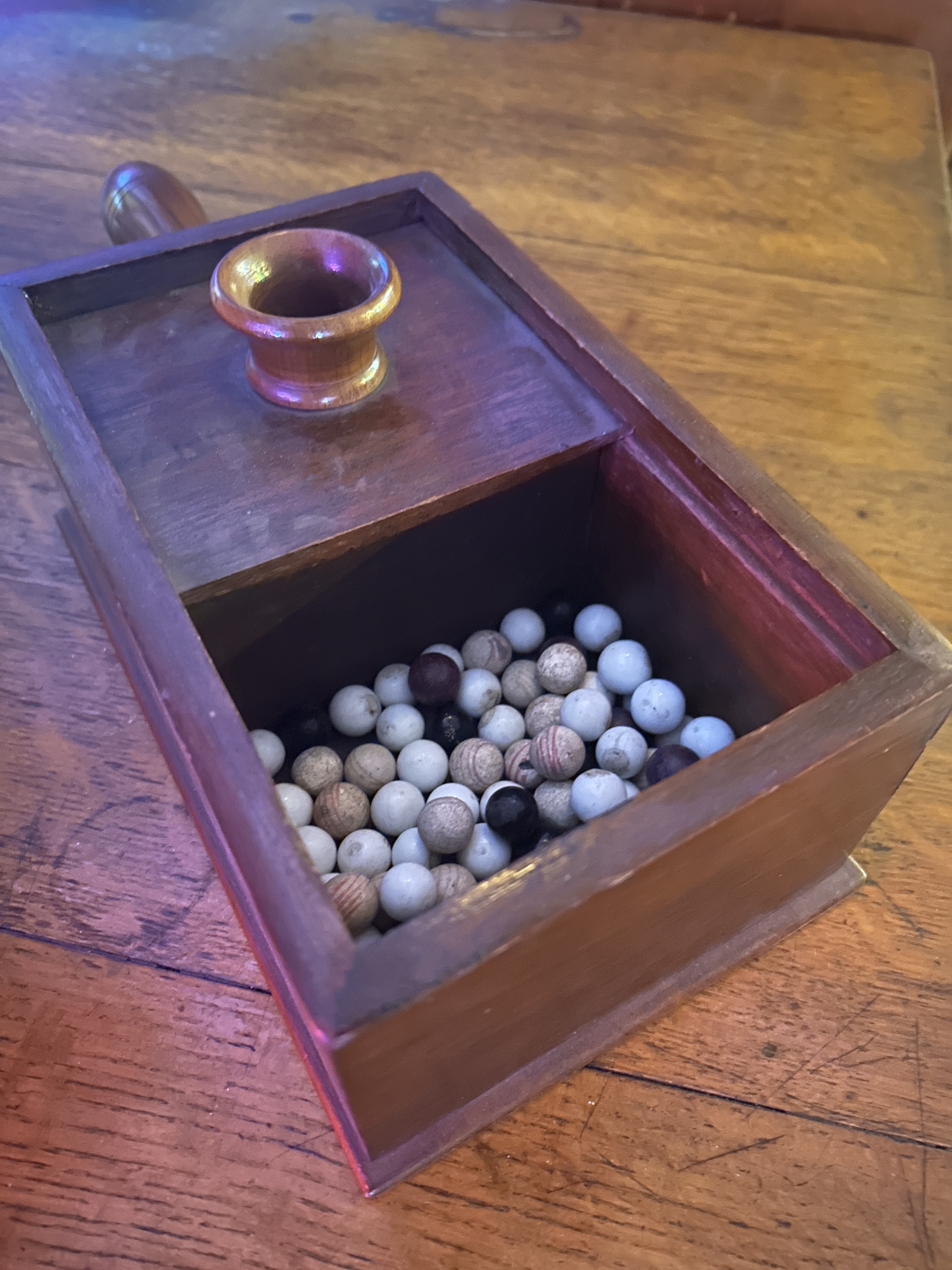
- Voting on new members – Before voting could occur, applications for membership were first checked by an appointed Investigating Committee. Good moral character was the foremost consideration. From the validated applicants, votes were then cast by the president, lodge officers, and past Grand Lodge officers with black and white balls. White balls elected. Black balls rejected. Local lodge bylaws dictated how many black balls a candidate could receive. In some cases, any amount of black balls rendered the candidate unacceptable. Rejected candidates were handled by the president according to lodge bylaws.
By the way, Hermann Sons membership is no longer subject to a vote.
- Initiation and oath – The initiation rite for new members was conducted solemnly:
- Candidates waited in the “anteroom.” Before being escorted into the lodge room, each person was asked three questions confirming a desire to become a member and a promise to comply with Grand Lodge laws and local lodge bylaws, and a third question:
- “Do you bind yourself, your heirs, executors, and administrators to make only such demands or claims against the Order as are guaranteed to you by the laws of the Grand Lodge and your local lodge bylaws?”
- “Do you bind yourself, your heirs, executors, and administrators to make only such demands or claims against the Order as are guaranteed to you by the laws of the Grand Lodge and your local lodge bylaws?”
- Candidates who did not answer Yes to all questions were given another opportunity during a special examination. If the candidate still did not answer affirmatively, the lodge would decide on a disposition.
- Complying candidates were escorted into the lodge room and instructed to sign the Initiation Book, considered a permanent record of the lodge.
- Among opening statements, candidates were informed that “you are not required to change your attitude towards your family for fellowman. The ODHS knows no distinction as to religion or politics.”
- Candidates raised a right hand to agree to several oath provisions, among them:
- “You promise that you will never speak evil of any member and that you will always stand ready to protect a member to the best of your ability. You further promise that you will never engage in any conversation that will be detrimental to this lodge or our Order.” (These three words were, in fact, the only underlined words in the ritual book.)
- “Upon your honor, you promise that you will not communicate the signs, passwords of the Order, or proceedings of your Lodge or any other Lodge to anyone who is not a member of our Order.”
- “You promise that you will never speak evil of any member and that you will always stand ready to protect a member to the best of your ability. You further promise that you will never engage in any conversation that will be detrimental to this lodge or our Order.” (These three words were, in fact, the only underlined words in the ritual book.)
- Next, candidates were acquainted with the aims and purposes of the Order, including the motto: Friendship, Love and Loyalty.
- The president then gave the candidates the password and salutation sign, described as “essential to being properly identified and recognized.”
Upon leaving the meeting, salutation signs were to be given by new members to the officer, and the officer was to answer by repeating the same sign. - In addition to the password and salutation sign, three other hand signs were shared, one indicating that a matter was to be kept confidential, one symbolizing love of the Order, and one signifying readiness to assist needy persons, along with instructions that hand signs were to be given with preciseness and passwords were to be communicated clearly.
- Sometimes regalia was given.
- Finally, candidates were presented and declared “true and worthy” members.
- To close the initiation ceremony, a history of Hermann Sons of Texas was shared, followed by a reminder that the organization is named after Hermann the Defender whose loyalty and faithfulness was an inspiration, serving as an example to all members.
- Candidates waited in the “anteroom.” Before being escorted into the lodge room, each person was asked three questions confirming a desire to become a member and a promise to comply with Grand Lodge laws and local lodge bylaws, and a third question:
- Burial services – Only in the event that no minister was available, the local lodge was to conduct the burial service of its members. The wording for the burial service was provided in the ritual book.
In the spirit of tradition, the hand signs and passwords will not be made public, but you can still find long-time members who might be willing to pass along the secret information to their fellow members. Wink.


by Jennifer Stanford | posted July 25, 2024
All rights reserved.
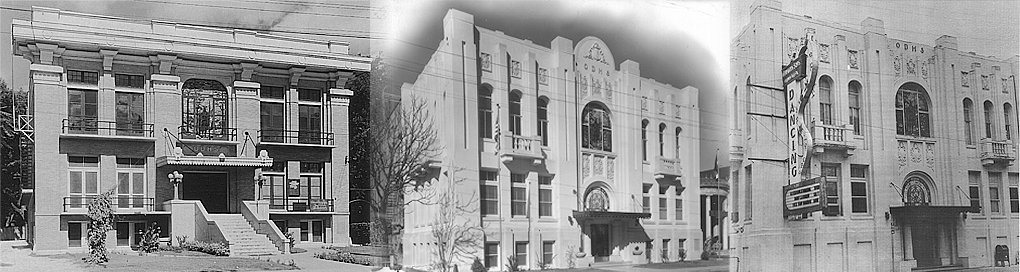
 Hermann Sons Hall
Leave a comment