

The Hermann Sons Home Association occupies a storied piece of land, but Hermann Sons is not its first story. In fact, our plot has been lived and walked upon by some members of notable 19th century San Antonio families, and sustained homes, stables, and trees that no longer exist.
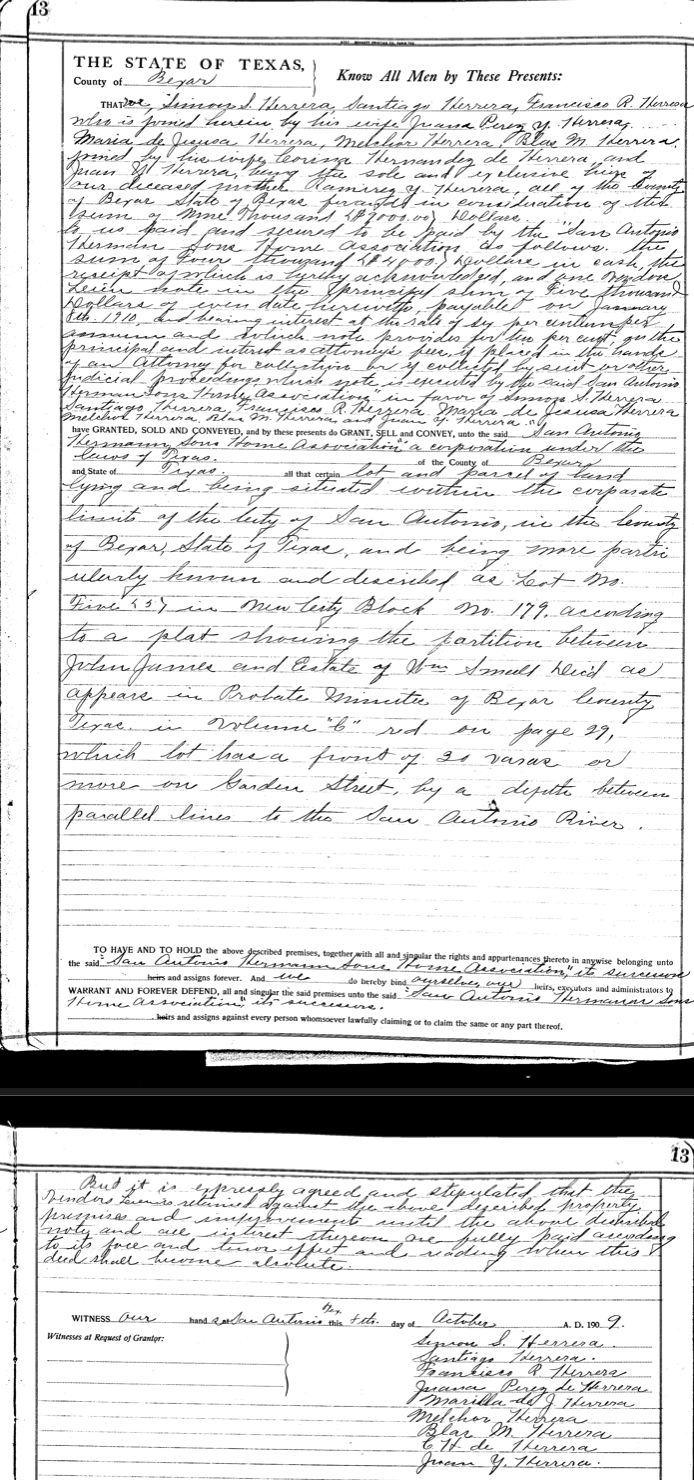
Start with a handwritten 1909 Bexar County deed. Grantors: the children of Francisco Herrera Sr and his wife Maria Luisa Ramirez de Herrera. Grantee: The Hermann Sons Home Association. Hermann Sons had found the location for its new permanent home.
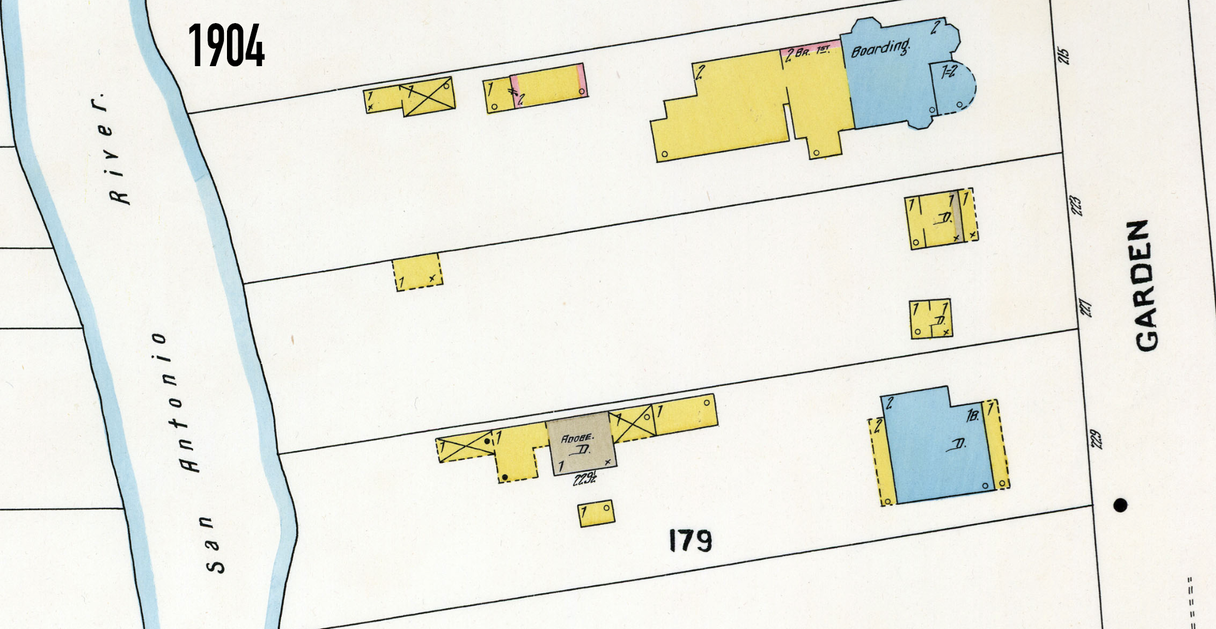
Maria Luisa, age 77, had died in her home at 223 Garden Street (present day 525 S. St. Mary’s Street) in 1906 and her seven children being the sole and exclusive heirs of their deceased mother, granted, sold, and conveyed unto the Hermann Sons Home Association for $9000 the parcel of land described as Lot No. 5 in New City Block No. 179… “which has a front of 30 varas or more on Garden Street, by a depth between parallel lines to the San Antonio River.” The lot was situated between the Presnall Hotel and the Duerler Homestead, with a grove of pecan trees in the back, and was considered part of the “oldest part of the city.”
Maria Luisa’s husband, Francisco Herrera Sr had died suddenly of cardiac arrest while attending a cock fight in 1885.
Maria Luisa’s obituary described her as “one of the earliest settlers of San Antonio…born in this city in 1829 and saw the city grow up from a wilderness.”
Maria Luisa married into the Herrera family in 1859 and birthed seven Herrera descendants. The Herreras were not only a prominent wealthy Mexican ranching family and “known all over Bexar County,” the Herrera family lineage begat several key characters in significant events in Texas history: Francisco Herrera Sr himself served in the Confederate Army, enrolled in the 2nd Regiment Texas Mounted Rifleman despite having lost an arm 12 years earlier. His father, Blas Maria Herrera served under Juan Seguin and has been called the “Paul Revere of Texas,” credited with alerting the Alamo command in February 1836 that Mexican General Antonio López de Santa Anna and his army were marching toward San Antonio. Francisco Herrera Sr was also the grandson of Colonel Jose Francisco Ruiz, one of the signers of the Texas Declaration of Independence, and nephew of Francisco Antonio Ruiz, the alcalde (mayor) of San Antonio in 1836, during the Battle of the Alamo.
223 Garden Street was referred to as both “the Herrera estate” and the “old homestead property,” about 15 miles from the Blas Herrera ranch located along the Medina River at the Garza Crossing in southern Bexar county, which is now listed on the National Register of Historical Places and contains remains of structures (‘jacales’) that date back to the 1830s considered to be significant examples of early Tejano building techniques. Interestingly, one of the original outer gates of the Alamo was discovered on the Herrera Ranch in 1984.
Between 1896 and 1900, at least two children died at 223 Garden Street, including 3-year-old Adelaide Herrera.
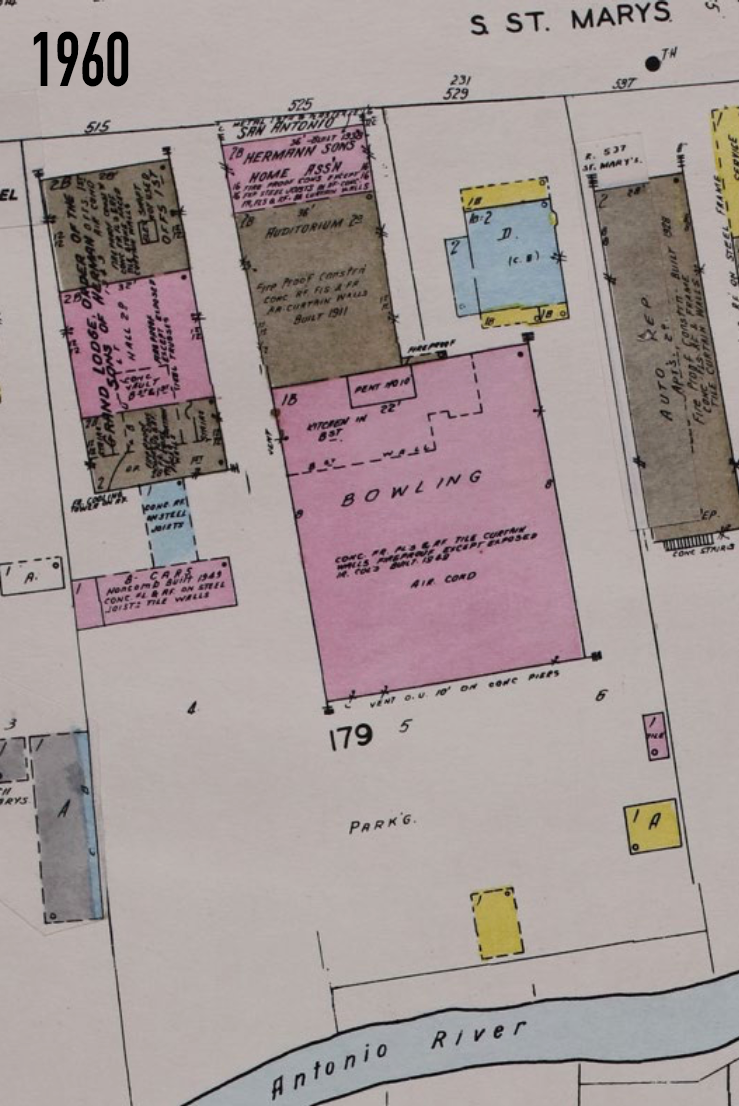
Moreover, the widowed Maria Luisa Herrera had a string of noteworthy Garden Street neighbors, just south, on the location of the present day Herman Sons ‘side parking lot.’
Hermann Sons Home Association acquired the adjacent lot (NCB 179 Lot 6) and its peculiarly built old home in 1945. The old home, referred to as the “Duerler Home,” served as a Hermann Sons youth activities center into the 1950s.
Gustav Anton Duerler, the last inhabitant of the Duerler Home, was a Swiss born confectioner whose family settled in San Antonio in 1849. Gustav Duerler acquired the Garden Street property in 1903.
Following his Confederate Army service in the Civil War, Duerler returned to San Antonio and opened “Schmitt & Duerler Cracker and Candy Factory” in 1868. The factory grew to become Duerler Manufacturing, a local candy empire with offices on Commerce Street and factories nearby, including one at present-day Camp Street Residences. Duerler was also the largest sheller and shipper of pecans in Texas at one time. Duerler Manufacturing endured into the mid-1930s, outliving Gustav Duerler who died in 1928, but ultimately succumbed to the Great Depression.
A full-page interview with Gustav Duerler appeared in an April 1922 edition of the San Antonio Express where he recounted his time serving as fire chief, city councilman, and manager of San Pedro Park. His father was the park manager before him, and he tells a story about a large jaguar that his father shot in the park when he was a boy.
The Duerler Home and lot were sold in 1942 to San Antonio Loan & Trust Co in a public sale, and then purchased by Hermann Sons in 1945.
Before it was the Duerler Home, the “fine residence on Garden Street” was purchased in 1894 by Will Sullivan, a “popular young banker” who bought it at a sheriff’s sale at the close of a rather odd chapter.
From 1889 to 1894 the property was both the residence and medical office of Dr. Henry Von Koehring, an eccentric physician and surgeon from Berlin, Germany who came to San Antonio by way of New Braunfels and married into the Witte family. He purchased the property in 1889 from William and Helena Koehler, who purchased it from the Adolph Huffmeyer estate in 1875.
Dr. Von Koehring was often in the news. Many of the stories portray a well-known, esteemed doctor and fine horse enthusiast who performed heroic medical feats, such as surgically removing a child’s eye and successfully treating epilepsy, as well as attending to terrible injuries including a severed arm and a baby who fell into a pot of boiling beans. Dr. Von Koehring was once described as “the most popular and successful doctor in the city” and “a gentleman in every sense of the word.”
The newspapers also reveal an outspoken doctor willing to air disputes publicly. In several insolently worded letters to the editor, Dr. Von Koehring publicly derided other doctors and officials for their alleged omissions, failures, and audacity to call themselves physicians – apparently making a few enemies. In one tit-for-tat response, Dr. Von Koehring was called an “unintentionally funny medicine man” and accused of “toting the prefix “Von” to his name… to let common people hereabouts know that he is blue-blooded” and he was mocked for his use of the title “Artzt” (a German word for physician).
Dr. Von Koehring married Emma Witte in 1893, daughter of real estate mogul George Witte, and brother of Alfred Witte for whom San Antonio’s Witte Museum is named. Though Emma filed for divorce at least once, it appears that the couple remained married until her death in 1903. Their son George was born in June 1894, given the name Von Koehring, but was renamed to George Witte Jr when he was still very young.
In 1895 Dr. Von Koehring left San Antonio in disgrace, briefly, following a highly publicized legal entanglement with his father-in-law, George Witte, involving an alleged letter threatening bodily harm, a perjury charge, and a $100,000 countersuit for damages to the doctor’s “good name, fame, and credit.” One day amid the legal fracas, the doctor was knocked down in the street with a cane, by his brother-in-law, after which a lively five-minute fist fight ensued at the corner of Alamo Plaza and Houston Street as a crowd gathered.
By the end of the year Dr. Von Koehring returned to San Antonio and lived his final years on Alamo Street. He died in 1904, age 58, and was reported to have predicted his own death.
Half a century later the Duerler House still stood, beside the Hermann Sons Home Association, and was used for various Junior Hermann Sons activities. In 1951 the Hermann Sons received an award from the San Antonio Conservation Society for having preserved the home of Dr. Von Koehring; however, by 1952 the Hermann Sons Home Association board minutes first mention suggestions that the structure should be dismantled and the space used for parking. By 1956 the board was resolved to dispose of the home, although demolition was delayed due to interest expressed by the Conservation Society in dismantling it themselves. Any efforts to save the building ultimately failed; the old home was finally demolished between 1960 and 1965.
—
Much thanks to Beth Standifird, Research Librarian at the San Antonio Conservation Society Foundation, for helping me connect some dots, and to Rick Pichardo, Real Estate Specialist at Bexar County Public Works for pointing me to the 1909 deed, the precipice of a pretty extraordinary rabbit hole.
by Jennifer Stanford | posted May 9, 2024
All rights reserved.
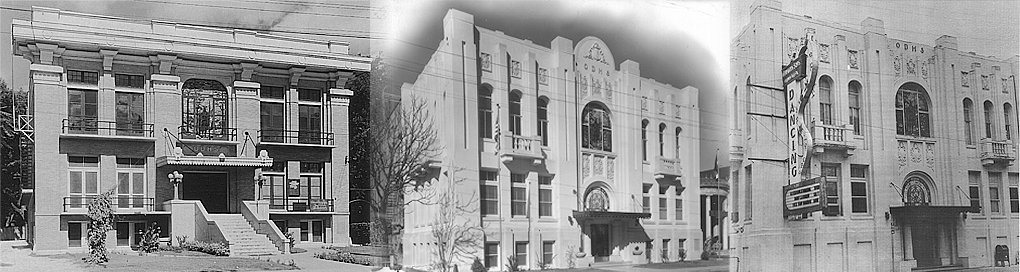
 Hermann Sons Hall
Leave a comment