

It’s January 1947 and the San Antonio Hermann Sons Home Association (HSHA) Board of Directors has just decided to build a bowling alley.
Now what?
Here are 50 steps — some of the highlights and most interesting details of this laborious multi-year process that took place in a post-war economy during an era of building material shortages, including steel shortages, federal building restrictions, and even the coldest date in San Antonio history (to date!) as undertaken by HSHA board members with unwavering determination to build something great that would be enjoyed by generations of members. Dates, details, and much of the language come directly from the actual minutes of the HSHA board meetings. Note that $100 in 1949 was the equivalent of about $1250 today.
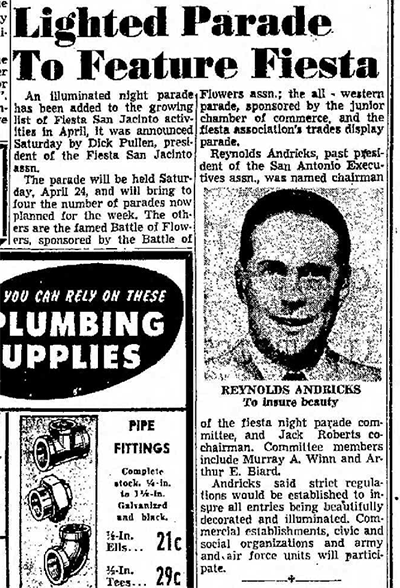
- Feb 12, 1947 – Employ Brother Reynolds Andricks as the consulting engineer to create preliminary plans for building a bowling alley. Andricks procured the architecture design services of Milton Ryan.
Of note, San Antonio’s beloved illuminated nighttime Fiesta Flambeau Parade is generally regarded as the “brainchild” of Reynolds Andricks, including its name. Andricks was a notable civil engineer and a member the Fiesta Association for many years.
- Apr 8, 1947 – Enter into a written contract with Reynolds Andricks covering development of the plans and specifications, as well as recommendation of bids from contractors and supervision of the project if pursued. Andricks would be paid 5 ½ percent of the total cost of construction.
- Jun 11, 1947 – Andricks presented and submitted the plans to the HSHA Board of Directors. A full discussion was held.
- July 8, 1947 – Andricks presented and submitted revamped plans intended to lower the total cost.
- Jul 8, 1947 – Set a deadline of October 15 for procuring bids and the expectation that the bowling alley construction would take 6 months to complete. (The construction ultimately took 21 months to complete.)
- Jul 20, 1947 – Hold a Special Meeting of HSHA members, according to HSHA bylaws, to procure authority from the entire membership to erect a bowling alley and make other improvements. A full discussion ensued regarding the plans, steps, financing, and wisdom of the venture.
A motion was made to authorize the Board of Directors of the San Antonio HSHA to build according to the plans, and to secure financing from the Hermann Sons Grand Lodge, not to exceed $220,000. This motion was passed on October 26 at a general meeting of the HSHA members; the board was authorized to proceed, and the authorized cost was raised to $280,000.
- Aug 13, 1947 – Pass a motion to immediately reduce the operating expenses of the HSHA, including the reduction of employees.
- Oct 8, 1947 – Hear a personal injury claim by Brother Leo M.J. Dielmann, architect, regarding his May 1940 contemplations and drawings for a proposed bowling alley. This claim was finally settled on February 11, 1948 for $500, as his claim was found to be valid.
Dielmann was the architect of the 1938 building expansion and would later be hired as architect of the Hermann Sons Grand Lodge, constructed in 1949-1950 next to the Home Association building.
- Oct 15, 1947 – Hold a Special Meeting of the board to accept the list of contractors supplied by Andricks for invitation to bid, and resolve to employ only union labor.
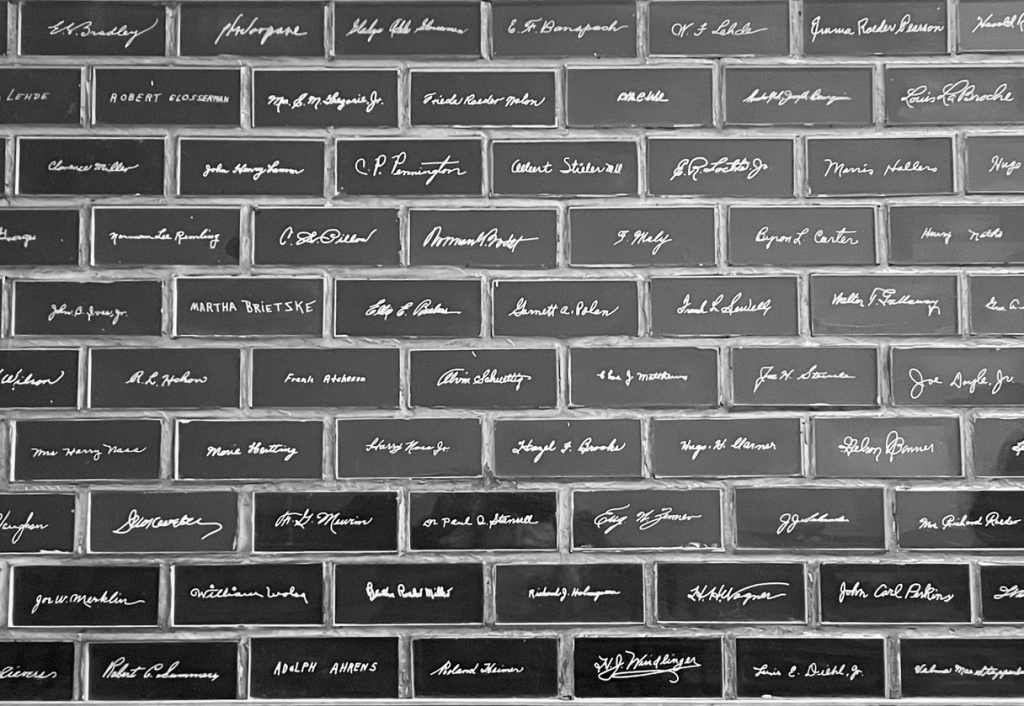
- Nov 14, 1947 – Endorse a fundraiser campaign to sell clear plastic “bricks” for $10, to be imprinted with the purchaser’s signature and installed in a prominent location. By April 1949 this fundraiser reaped $5209.27 through selling 672 bricks. The bricks were originally installed in the ramp to the bowling alley but were moved to the middle floor of the Home Association building in 1955 where they can still be viewed today.
- Dec 10, 1947 – Halt the bowling alley project due to reports that Hermann Sons would almost certainly not be able to obtain authority from the US government to build a bowling alley due to the Housing and Rent Control Act of 1947 which restricted construction of amusement and recreational buildings because of post-war shortages of building materials and residential housing. The restrictions were set to expire at midnight February 29, 1948.
- Jan 20, 1948 – Send a telegram, followed by a letter, to US House of Representatives member Paul Kilday urging him to use his influence to vote against the extension of the restriction on the grounds that “juvenile delinquency can be blamed on the lack of amusement places for building the moral and physical structure of our youth.”
Send similar correspondence to US Senator Tom Connally.
- Jan 21, 1948 – Be advised by the secretary of the National Bowling Council that the application for the erection of the bowling alleys should not yet be filed because it would be rejected.
- Jan 21, 1948 – Unanimously pass a motion to enter into a contract with John F. Cunningham, contractor, for the construction work pertaining to the bowling alley, effective Mach 1, 1948, provided that the federal restrictions would be lifted.
Cunningham Construction’s legacy also includes the Lanier High School gymnasium and the Bel Aire apartments.
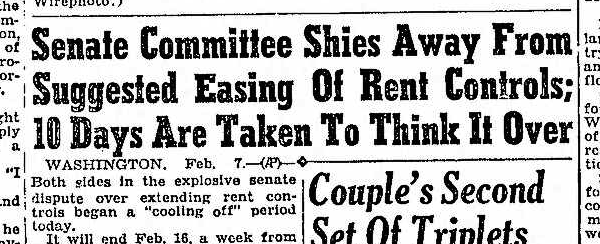
- Feb 25, 1948 – Receive a telegram from Senator Connally stating that “an amendment to the bill passed by the Senate yesterday permits construction without permit, of recreation facilities operated by schools or churches or by private interests if made available for similar organizations.”
- Feb 28, 1948 – Continue halting the bowling alley project due to a 30-day extension of the Rent Control Law. Congress had not agreed on an extension program, and a stop-gap bill was passed (HR 5390) extending controls until March 31. However by March 25 Congress agreed on a bill (S 2182) extending controls one year but with certain controls lifted, including those affecting construction of bowling alleys.
The board was advised to stand by, and Andricks stated that he would immediately refer to the board any new developments learned of through his contacts in Washington D.C.
- Mar 27, 1948 – Hold a Special Meeting of the HSHA members to discuss entering into the final arrangements for construction, with the expectation that under the new federal Rent Control Law “all restrictions pertaining to the erection of bowling alleys would no longer be in existence and would leave the way clear for immediate construction” effective March 28. The board acknowledged that the delay may have resulted in an increase in labor and material costs of less than $5000.
Members were solemnly reminded that the future of the Home Association would depend on the success or failure of this project.
- Apr 1, 1948 – Issue a resolution acknowledging “the efforts of the Honorable Paul Kilday, M.C. in having the Federal Rent Control Act passed without the inclusion of any restrictions pertaining to the erection of facilities pertaining to entertainment purposes… “ and hereby expressing “our thanks to him personally…”
Representative Kilday would visit the bowling alley in October 1949 and state that he was proud to have been of service to the Hermann Sons.
- Apr 9, 1948 – Renegotiate the loan from the Hermann Sons Grand Lodge in the amount of $215,000 because the original commitment had expired. The sum was borrowed at the rate of 4 1/2% per annum, with all interest to be paid on October 1 and the principal to be paid in monthly installments of $1360 on the first day of the month beginning November 1, 1948 until December 31, 1958.
- Apr 14, 1948 – Hear tentative bids from three bowling equipment companies for lanes and installation:
- Alamo Billiard and Supply Co representing the American Bowling and Billiard Corporation ($65,478)
- Bromfield Ritter Co of Texas ($65,474)
- Brunswick-Balke-Collender Co (present day Brunswick Corporation) ($67,669.50 plus freight)
It was agreed that the bid from Brunswick-Balke-Collender, though higher than the others, had more merit and included more of the desired features. A recommendation was made to enter into a contract with Brunswick-Balke-Collender to furnish all bowling equipment for a 20-lane bowling alley, seating, necessary materials, and installation for $72,947.58. A financing plan would be set up with Brunswick-Balke-Collender to be secured with 35% down and payments over 5 years with 12% non-cumulative interest (less than 6% per annum).
- Jul 14, 1948 – Having agreed upon a bowling schedule, announce the schedule of bowling dates to the entire membership through the Hermann Sons newspaper, and ask that those wishing to bowl send their application at once.
- Jul 14, 1948 – Following a discussion on the operation of the bowling alley, appoint a committee for the recommendation of a bowling alley manager. This committee was charged with recommending the type of manager needed, the qualifications required, and the expected accomplishments.
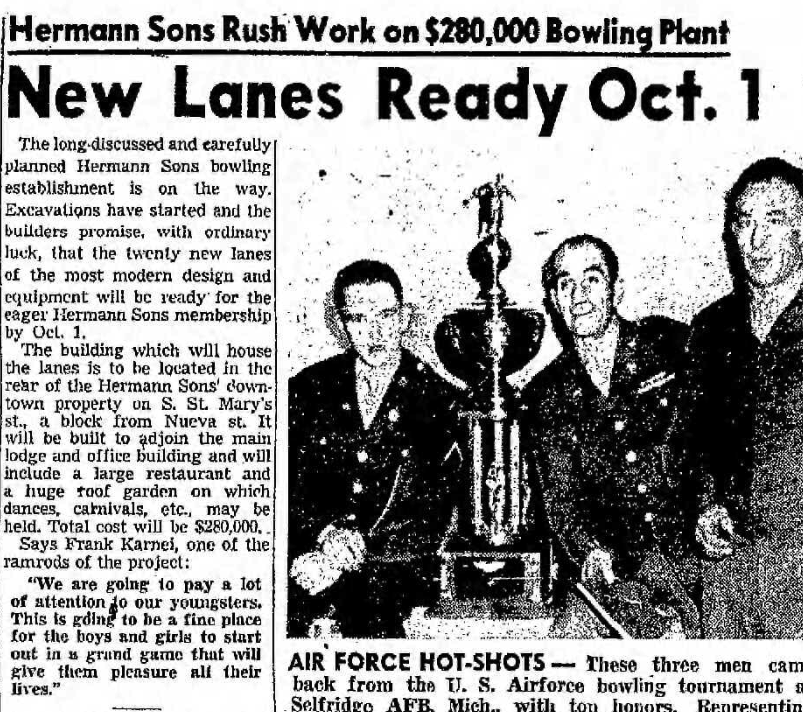
- Sep 8, 1948 – Report a delay in construction due to the shortage of steel columns.
- Sep 8, 1948 – Indefinitely postpone the 1948 Hermann Sons Carnival (traditionally held the first weekend of October) due to the ongoing construction, and instead hold a few dances on the nights assigned to the Carnival.
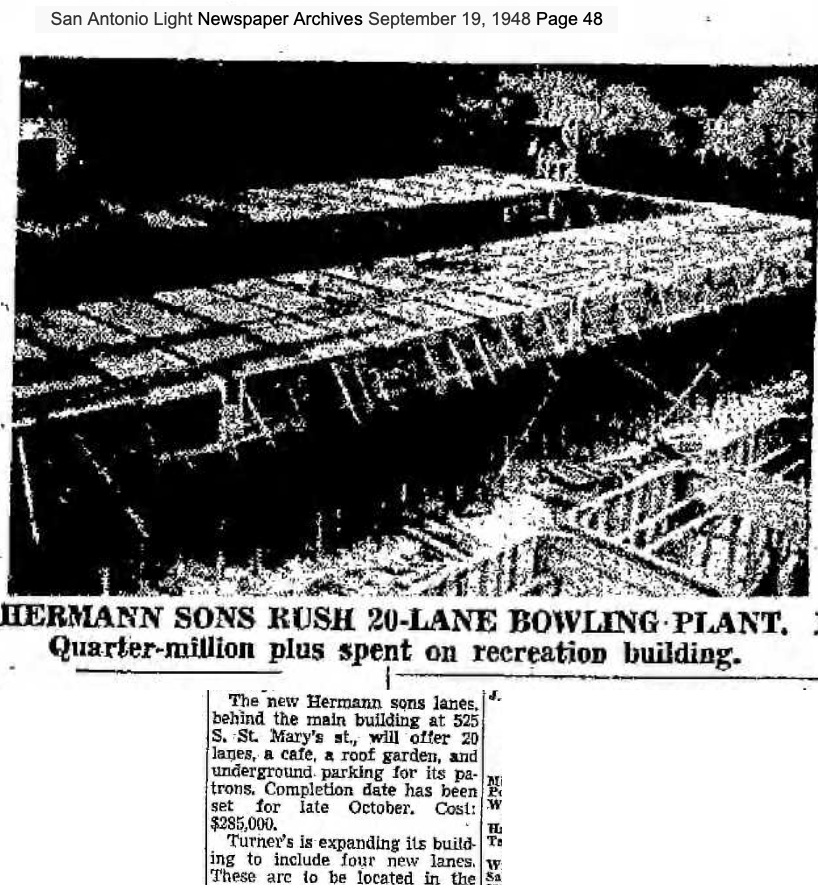
- Sep 13 1948 – Hold a Special Meeting of the board at which a motion was passed to cash $7500 in Hermann Sons Carnival War Relief Bonds to be used as downpayment on the bowling lanes and associated freight, as the lanes and equipment had been shipped by the manufacturer.
- Oct 13, 1948 – Interview the first applicant for bowling alley manager, George Tucker, who “left the impression of having a good knowledge of such an undertaking.”
- Oct 18, 1948 – Amidst concerns about the delays in construction, hold a Special Meeting of the board to address speeding up the completion of the bowling alleys. A conference with Andricks was called.
- Oct 23, 1948 – Call a follow-up Special Meeting of the board to hear the president’s report regarding the conference with Andricks. It was reported that delays were due to not receiving the necessary steel columns, and not the fault of the contractor. Barring any further difficulties, the completion was now scheduled for no later than February 1, 1949 but an attempt would be made to complete the project before January 15.
Steel shortages continued into the early 1950s, which would also affect the ability of the Home Association to procure the required fire escapes the following year.
- Nov 8, 1948 – Form the nine-member Bowling Alley Committee.
- Dec 13, 1948 – In an effort to bolster income for the Home Association, notify all members that the Home Association must return to its former custom of obtaining revenue from the operation of the hall for dances. Until further notice, only the Home Association would receive revenue from all dances held on Saturday and Sunday nights and holidays. Use of the hall on other nights could be requested.
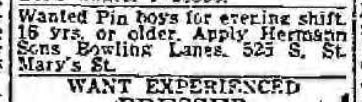
- Jan 22, 1949 – Hear a Finance Committee report on research conducted with other San Antonio bowling alleys in which it was determined that it would be necessary to produce an income of 20,000 lines per month at 25 cents per line and pay pin setters 6 cents per line. Personnel required to operate were identified: Manager, Assistant Manager, Part-time Assistant Lady Manager, and operating staff of about 14 ranging from maintenance man to foul line boy, with salaries totaling about $3300 per month.
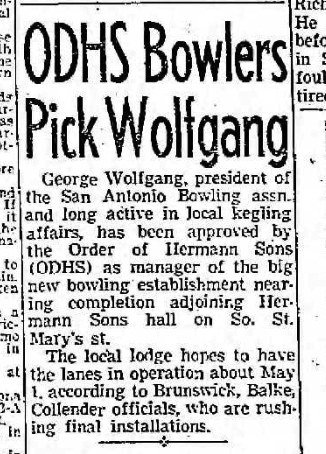
- Jan 22, 1949 – Interview a second applicant for bowling alley manager, Brother George Wolfgang, who was favored by Brunswick-Balke-Collender, as they thought him very capable especially from a promotional standpoint (he was a well known lanky left-handed contender in the local kegling scene and president of the San Antonio Bowling Association), though they acknowledged that Goerge Tucker was more experienced in the operation of a bowling alley.
- Feb 3, 1949 – Upon reading a letter of application submitted by Wolfgang in which he “attempted to outline the terms and conditions of his employment,” the board determined that he was not familiar with requirements of operating a bowling alley under a board with corporation status. The board was cautioned that it should in no way surrender its power when choosing a manager. Wolfgang would be given another hearing.
- Feb 3, 1949 – Hold second interview with Mr. Tucker. His salary requirements were $400 per month with a preference for a one-year contract.
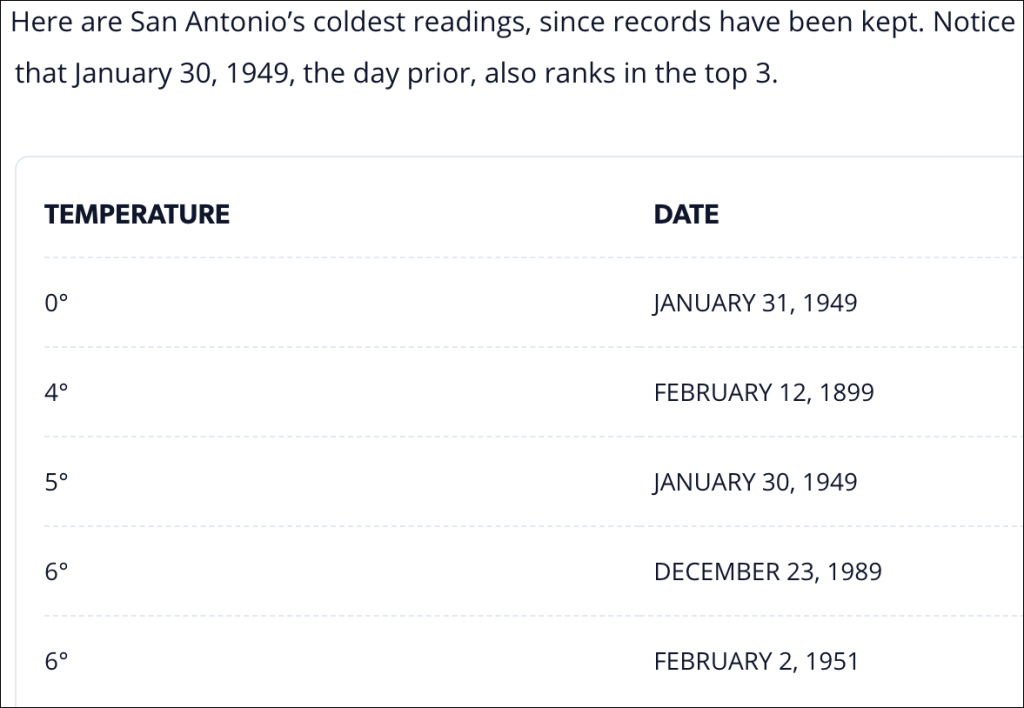
- Feb 3, 1949 – Hear a report by the Brunswick-Balke-Collender representative regarding delays in the installation of the bowling lanes due to temperatures on January 31 reaching zero degrees with five inches of snowfall, leaving the building too damp for proper emplacement. The installation was postponed to February 14.
To date, January 31, 1949 holds the record as coldest day in San Antonio history with temperatures dipping down to zero. January 30, 1949 is the third coldest day on record.
At that meeting the Brunswick representative pitched a Tel-E-Foul system, at a cost of $95 per alley, which would “keep your bowlers foul-line conscious” by automatically detecting and counting when a player crossed the foul line. He also recommended installation of semi-automatic pin setters at a cost of $220 per alley which he would formally propose at a subsequent meeting.
- Feb 7, 1949 – Interview a third applicant for bowling alley manager, Charles Kaiser, whose salary requirements were $500 per month with increases every six months. Mr. Kaiser was manager of the Tower Alleys in Austin at that time.
George Wolfgang was also given a second interview at which he stated his salary requirements as $450 per month with no annual contract.
A roll-call vote on bowling alley manager applicants was called. Board members were asked to set aside all personal differences. With 5 names being considered the board was asked to name a first and second choice. Wolfgang received 9 of the 13 first-choice votes.
- Feb 7, 1949 – Agree to enter into a contract with Brunswick-Balke-Collender for a Tel-E-Foul system, as the board was ever committed to keeping the lanes as modern as possible.
- Feb 9, 1949 – Upon realizing that no provisions had been made for the installation of a control counter, which would be very essential for bowling alley operation, order the Building Committee to arrange for the installation at a cost of $220.
Other necessary features omitted from the original plans were a drinking fountain and electrical hookups for the air conditioning units.
- Feb 9, 1949 – Hear a presentation from Brunswick-Balke-Collender recommending the installation of semi-automatic pin setter equipment, which was promoted as having many advantages such as saving money and providing faster operation, less noise, and “satisfied pin boys.” A motion to order and install the equipment was passed.
The Hermann Sons Bowling Lanes would initially open with semi-automatic pin setting equipment. The fully automated system would be installed in 1955.
- Feb 19, 1949 – Form a committee to execute the contracts for the bowling alley manager and assistant manager. The manager would then select and hire the necessary employees with board approval.
- Feb 19, 1949 – Instruct the Publicity Committee to get the publicity “wheels in motion” relative to the opening of the bowling alley.
- March 9, 1949 – Employ George Wolfgang as the first Bowling Alley Manager effective March 16.
- Mar 24, 1949 – Hold a Special Meeting of the board to plan and set a date for the formal opening, tentatively scheduling the event for the weekend of May 7.
As soon as the arrangements could be made to have the lanes sanctioned by the American Bowling Congress, the bowling alleys would be open for bowling including team play, league plan, and individual bowling.
- Mar 24, 1949 – Establish that the cost for bowling would be 25 cents per line. For boys and girls bowling in an afternoon league the charge would be 20 cents per line. Lockers could be rented for $2 per year. The cost of shoe rental was never mentioned.
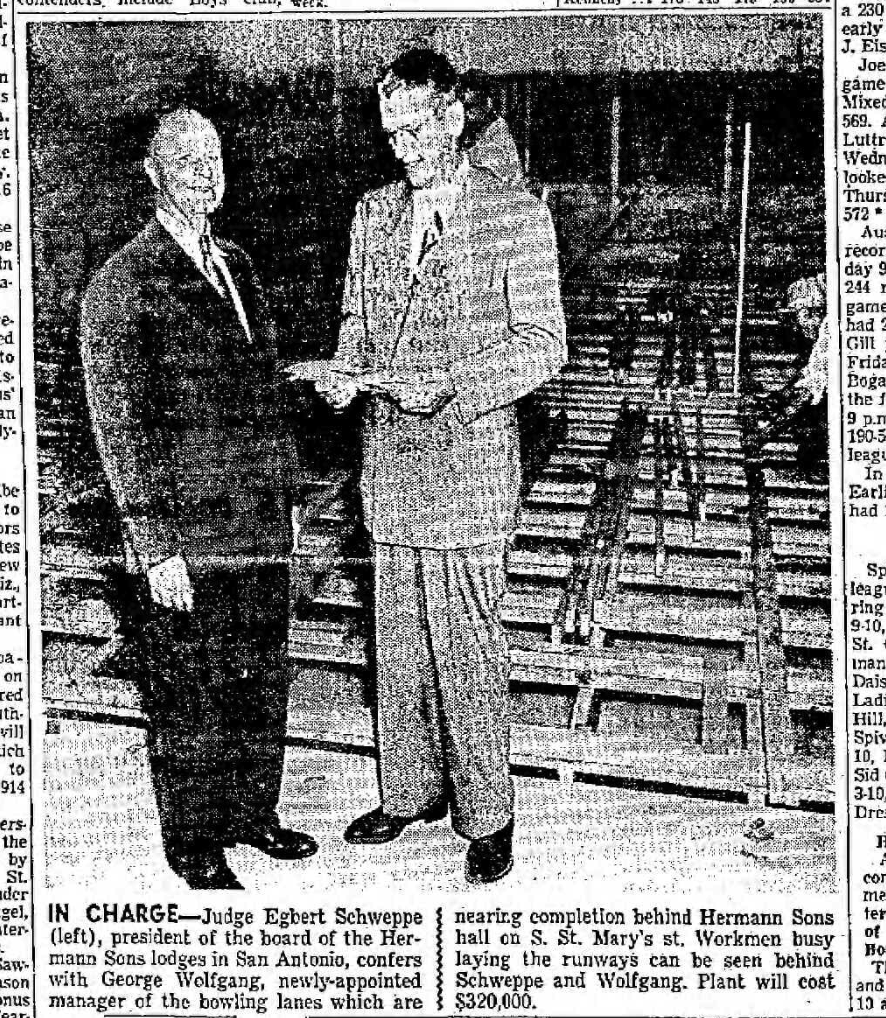
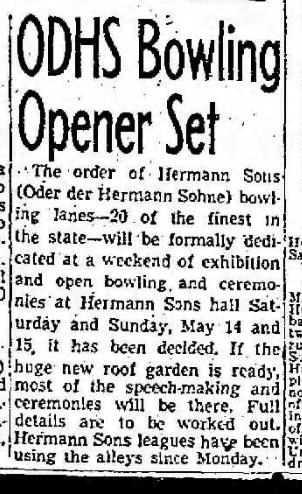
- Apr 12, 1949 – Open the bowling lanes for the first time. Lanes were open to leagues only during the first days of operation.
- April 13, 1949 – Hear Wolfgang’s first official Bowling Alley Manager report. He spoke on the necessity of having rules and regulations posted and was given approval by the board to proceed, as this was within his jurisdiction.
- May 11, 1949 – Hear report from Wolfgang announcing the resignation of his assistant manager and dissatisfaction with the bowling alley cafe operation, as well as a recommendation to purchase an automobile to be used for conveying the pin boys home.
A motion was passed to purchase an International Panel Truck which had been offered for $450, provided it was found to be in good mechanical condition. This vehicle was used until December 1951, at which point a head pin boy was employed to take care of transportation; the Bowling Lanes Committee was instructed to sell the truck.
- May 11, 1949 – Start paving the property, which was necessary because heavy trucks would be needed to deliver materials for the roof garden. The need for flood lights and fencing on the grounds was also discussed.
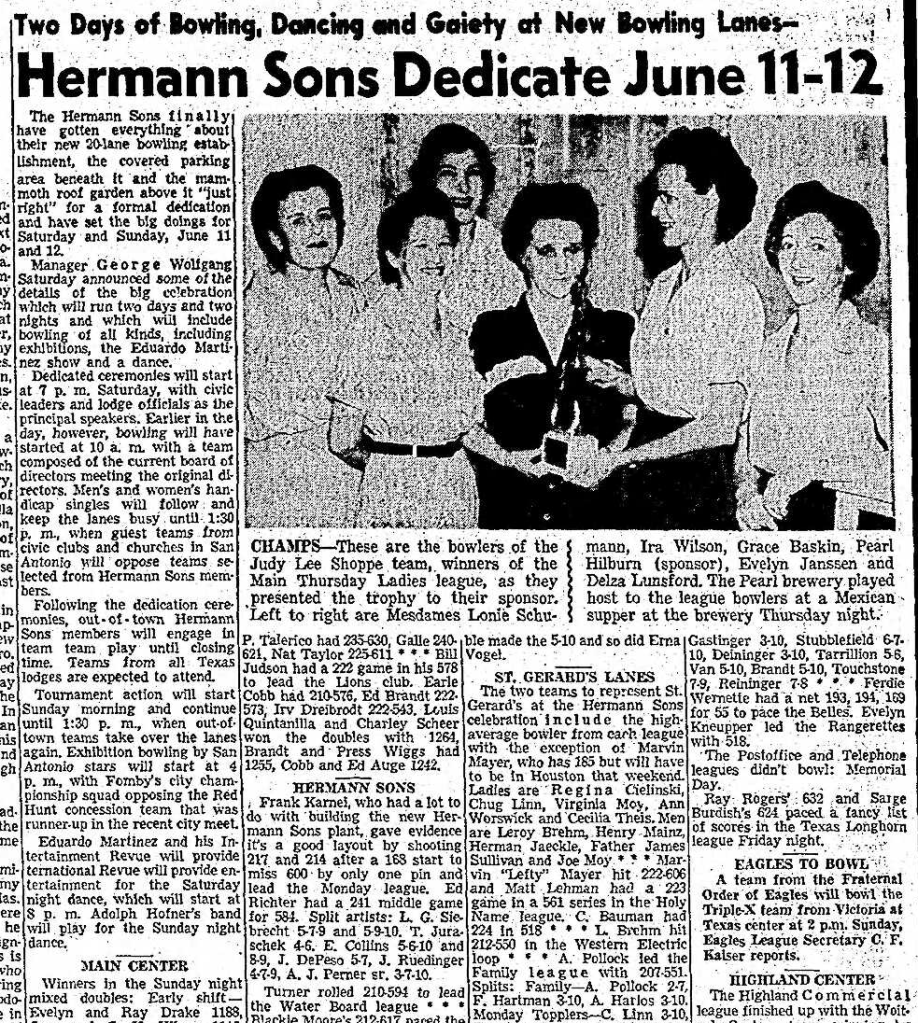
- May 30, 1949 – Hold a Special Meeting of the board to discuss the formal opening of the bowling alley, now scheduled for June 11-12, as well as financial and operating conditions.
It was decided that open bowling would only be permitted by
- Members, or
- Unmarried children of members who were living in the same household, or
- Prospective candidates who were vouched for and a guest of a member while bowling.
- Guests of members would have the privilege to bowl only one time.
Prices were set for beers: 17 cents for state beers and 22 cents for out-of-state beers.
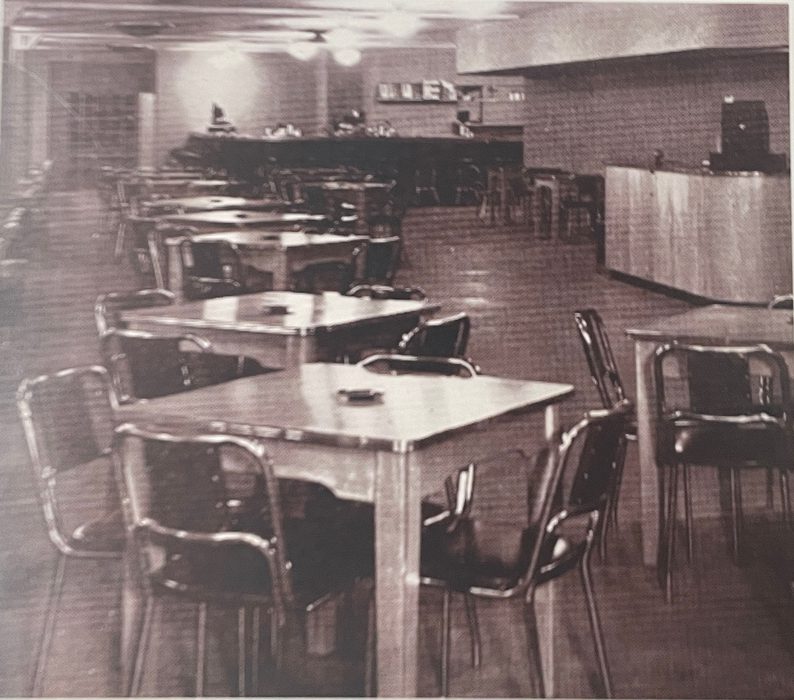
The board also agreed to purchase 1000 steel chairs at a cost of $3.15 each (tables had been purchased in March), and that a plaque would be installed reflecting the names of all members who operated as a board member during the years the bowling lanes were being planned and built, “for history’s sake.” A Plaque Committee was appointed.
Most of those original 1000 chairs are long gone, but the remaining chairs are still used today in the Rathskeller Bar.
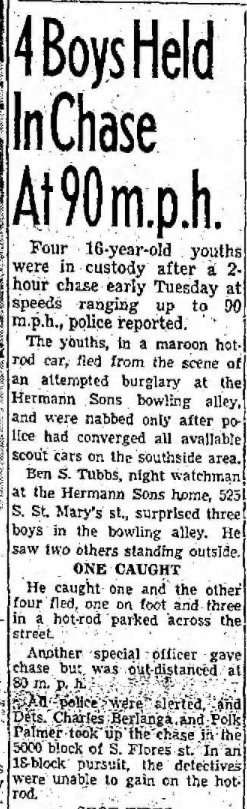
- May 31, 1949 – Catch several 16-year-old “youths” attempting to burgle the bowling alley. Upon being surprised by the Hermann Sons night watchman, the boys fled the scene but were nabbed by police after a 90-mile-per-hour chase that ended on the south side of town.
- Jun 8, 1949 – Hear a report by the Building Committee chairman stating that the next “headache” was use of the grounds for parties now that it is used as a parking lot. The issue was thoroughly discussed then held in abeyance pending completion of the Grand Lodge construction.
50. Jun 11-12, 1949 – Host the formal opening and dedication ceremonies for the bowling alley and roof garden.
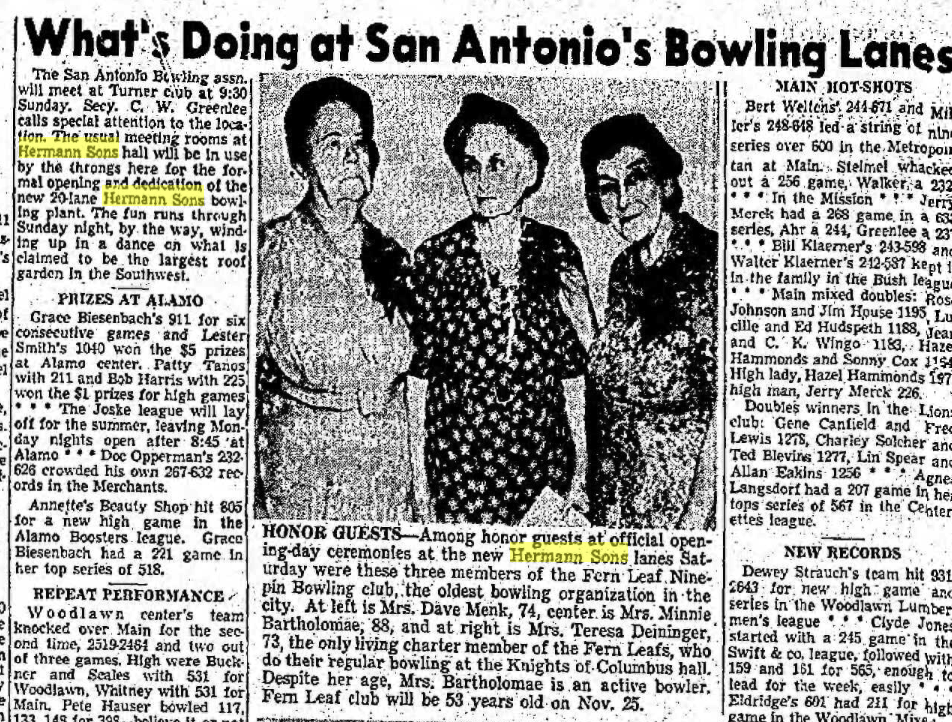
The Hermann Sons Bowling Lanes and rooftop garden opened with great fanfare on June 11, 1949. The months and years that followed were difficult for the Home Association as they embraced the new venture of operating a bowling alley and cafe, and hosting a lively dance scene on the rooftop, but through it all the board members were resolved and proud of their accomplishments, and grateful to each other for their dedication.
George Wolfgang resigned in June 1950; a string of rapid turnovers in the bowling alley manager position followed, seemingly due to the excessive time demands and stress of the job. (Shortly before resigning Wolfgang reported that he was averaging 80 hours per week.) The air conditioner was a perpetual maintenance problem, as was the rooftop dance floor. Petty theft and bowler conduct were also issues at times. There was also never-ending difficulty in limiting bowlers to bona-fide Hermannn Sons members; non-members seemed to find ways onto the lanes. In time, tournaments were scheduled where public participation was allowed, but bowling was usually limited to members.
Managing the bowling alley cafe was a real challenge in the early years. Responsibility for the cafe was passed back and forth, sometimes handled by the bowling alley manager, and sometimes managed by the House and Bar committee.
In 1950 after the first full year of operation, it was reported that 231,628 lines were bowled, on average 662 lines per day, falling somewhat below the 240,000 lines per year the board had hoped for. Over the next few years the bowling alley started to turn a profit.
By 1955, feeling in good financial condition and “realizing that, if the Home Association lanes [loose] their place as the most modern and outstanding establishment in our City, a terrific loss will be suffered and our competitors would march ahead” the HSHA board unanimously voted to purchase 20 fully automatic pin setters; the cost was offset by trading in the semi-automated pin setting equipment and being “free of the wage-expense for pin-boys.” At $185,240 the new equipment cost more than half as much as the entire original bowling alley and was financed over 7 years.
The Hermann Sons Bowling Lanes finally closed its doors in 2005.

by Jennifer Stanford | posted February 29, 2024
All rights reserved.

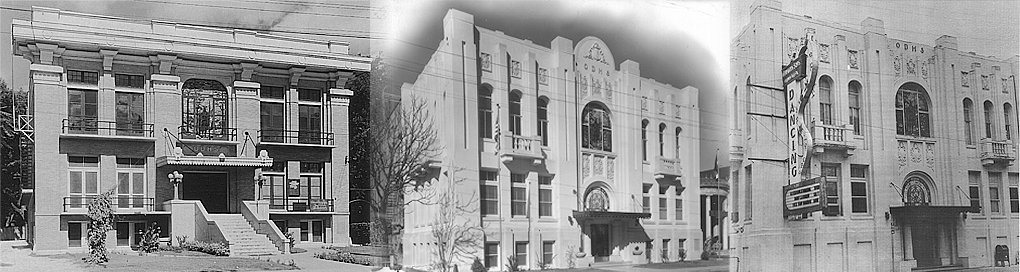
 Hermann Sons Hall
Leave a comment