

Hermann Sons was initially founded in 1840 — not as an insurance company, but as a brotherhood intended to foster German customs and German benevolence on this continent, and to be humbly in service to each other. The use of the color red in the Hermann Sons logo was meant to signify ties to German spirit and culture. In fact, its initial charter called for the use of “the German language perpetually in all its proceedings.” Mastery of the tongue of the fatherland was initially required for membership. The life insurance component of membership was not added until 1873.
Founding a German language school was a natural corollary, a popular idea at the time, and eventually adopted as an important mission of the Texas Hermann Sons – to “perpetuate the German Among Them.”
One April Sunday in 1894 at a meeting among three San Antonio Hermann Sons lodges — Harmonia , Seimering, and Werder — it was agreed that a German language summer school would be inaugurated “for children of members and others, during the term the public free schools are closed…” in which “nothing but German branches will be taught and the course embraces reading, writing, grammar, history, and composition.” A committee of members of the three lodges was formed to see to it.
This German language summer school would endure for more than 40 years under the Hermann Sons auspices.
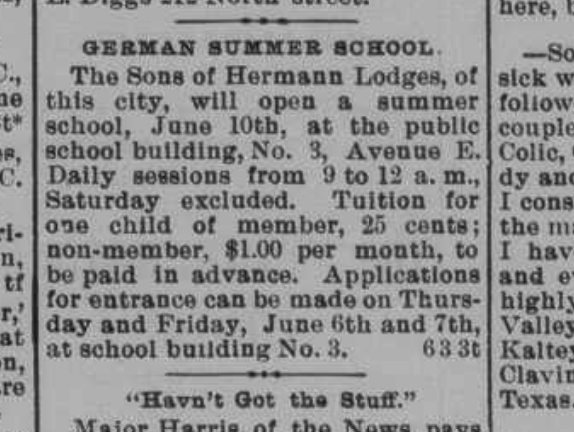
It was agreed that all Hermann Sons members would be taxed 25 cents per month (about $9 in today’s prices) to support the school. Tuition for children of members would be an additional 25 cents per month, and non-members would pay $1 per month. Tuition never surpassed $1.
In May 1894 the first of many concerts and balls was held in support of the school. The first was a lively event held in Muth’s Garden (on Grayson Street across from the Fort Sam Houston Quadrangle) with entertainment provided by Prof Muth’s “splendid” orchestra where “quite a nice sum” was raised for the proposed school from admission of approximately 1000 attendees. Throughout the school’s duration Hermann Sons hosted regular balls, dances, and events to raise money specifically for the school; for many years there was a mask ball each February, and later an annual “prize card and bunco party.”
The school opened its doors on June 8, 1894 with daily sessions from 9AM-noon and about 100 students in attendance. Classes ran into August. With permission from the city, the school met in Public School Building #3, a long-gone schoolhouse on the corner of Avenue E and Fourth Street that was renamed to Avenue E school, later moved, and would ultimately become De Zavala Elementary.
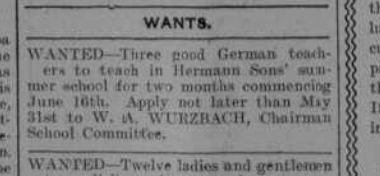
The first years of the summer “vacation” school were supervised by Professor Alexander Kuhn, the principal of the public schools German department, and three carefully selected assistants.
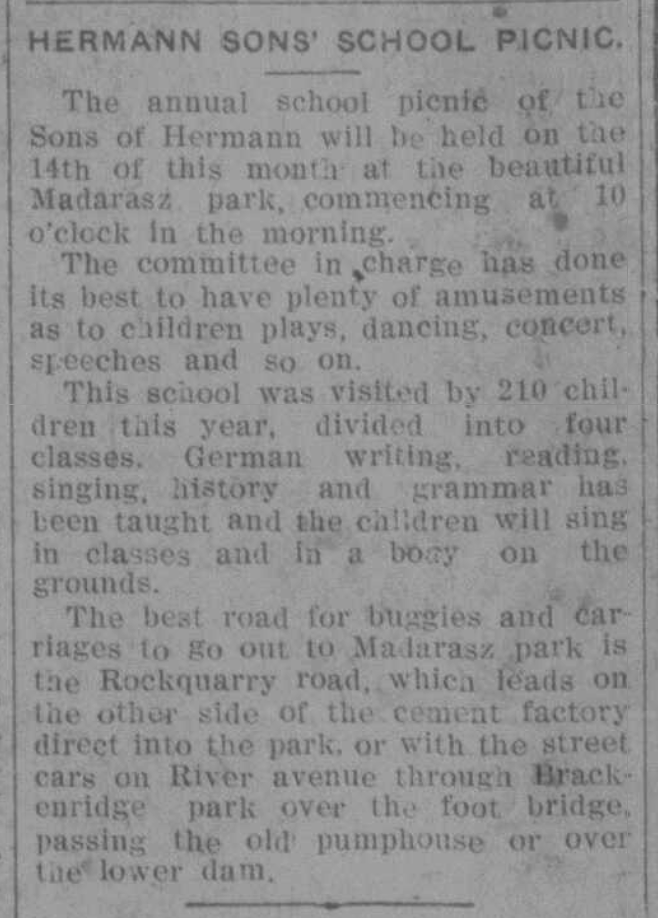
The summer classes concluded with a Sunday picnic where great appreciation was shown to Prof. Kuhn, prizes were awarded to students, and a string band furnished music as “family groups sat around tables under big shady trees,” a tradition that would continue for years.
The lending of public schoolhouses to certain groups, and not others, was not without controversy, and the need for German language education was questioned at times. In fact in 1900 the school board rejected the Hermann Sons petition for use of the schoolhouse amidst school board discord, so the school met at Turner Hall that summer (present day Bonham Exchange dance club), but was once again granted use of a public schoolhouse in 1901.
In 1909 as Hermann Sons began making plans to build a new hall (the present day Home Association building), the original intention was that “a suitable place may be provided for the holding of the annual German Summer school.” In the end, the schoolrooms did not make it into the final plans, so the German summer school continued operating in lent public schoolhouses throughout its existence, including Brackenridge, Paige, and Bonham.
It should come as no surprise that the school met challenges during The Great War. In 1919 the Texas Legislature passed House Bill 304 prohibiting the teaching of German in any public school, college, or university, reflecting a broader national trend toward restrictions on the use of the German language in public spaces, schools, and various institutions. Other measures such as the Texas Loyalty Act of 1918 contributed to widespread anti-German sentiment. Yet the measures and attitudes were not permanent, and the Hermann Sons German summer school endured another two decades.
The school ultimately closed in the early 1940s, during World War II, a fate common to most German language schools across the country, just as German language publications such as San Antonio’s Freie Presse für Texas ceased operations.
By the way, all Hermann Sons business was conducted in German until 1921. The change to English was initiated upon the Texas Hermann Sons withdrawal from the National Order of the Hermann Sons, when it became a completely separate entity. Included in the recommendation ratified by delegates at that convention, “all matters pertaining to the Grand Lodge must be conducted in English;” the transition took 16 years to complete and was not fully realized until 1937. It should also be noted that Hermann Sons membership has been open to all people for almost 30 years.
We still have active members who learned German before English, and we continue to honor the German heritage of our founders in various ways. Although the life insurance component of membership still exists today, the spirit of community and service remains at the heart of lodge membership.
Image dates L-R: August 11, 1904, June 4, 1895, and May 21, 1902
by Jennifer Stanford | posted December 28, 2023
All rights reserved.
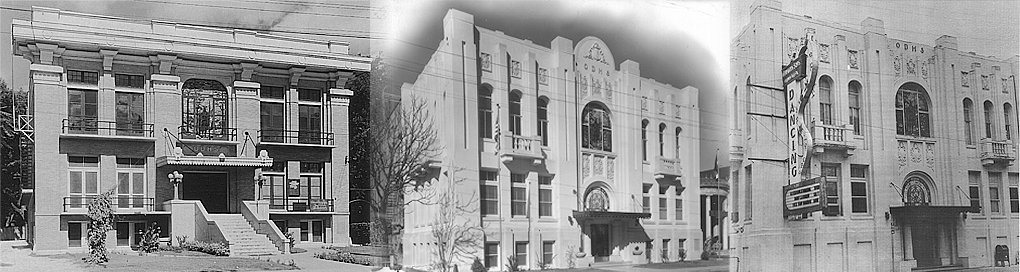
 Hermann Sons Hall
Leave a comment