

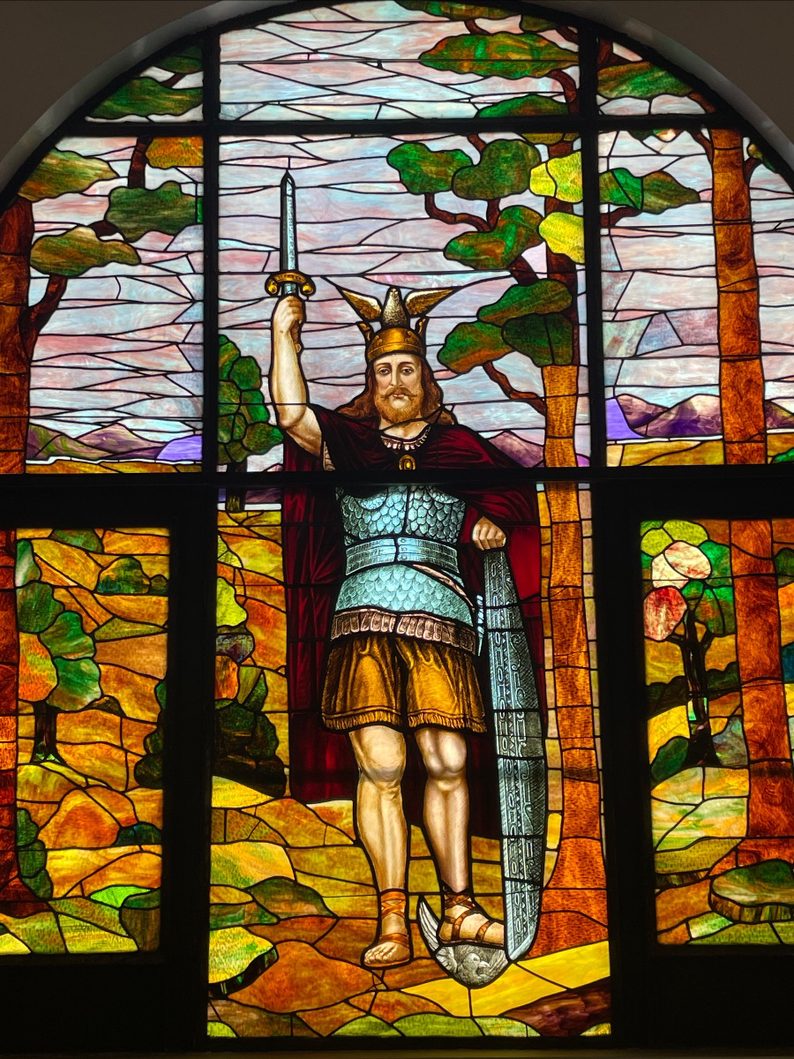
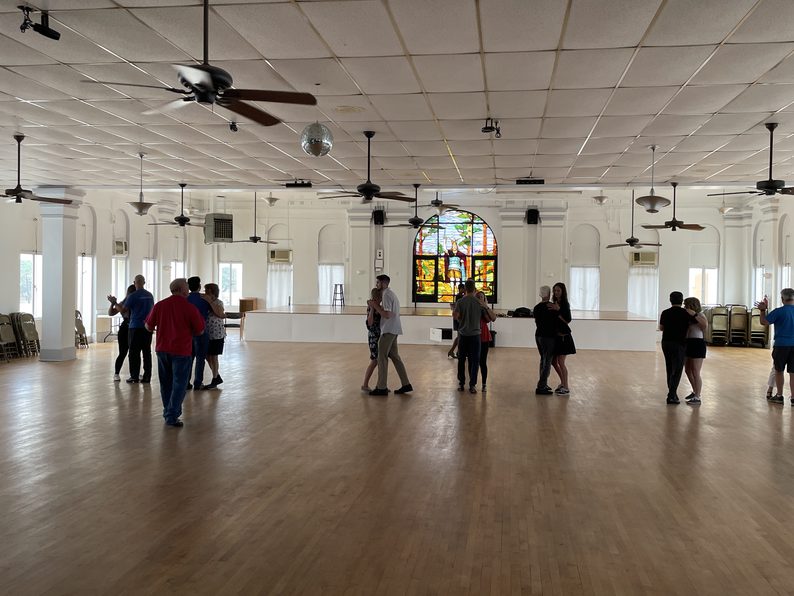
Though the grand church-like stained glass window in the Hermann Sons ballroom imparts an air of tropological instruction, its story is rooted in secular events that predate the baptism of Jesus.
He goes by several names.
“Arminius”
“Hermann the Cherusker”
“Hermann the German”
Who is Hermann the Cherusker, and why is he standing on a bird?
Cherusci were a Germanic tribe with origins in the first century BC, originally allied with the neighboring Roman Empire. Sons of the Cherusci elite were typically educated in Roman schools, learned Latin, even sent to serve in the Roman army. Arminius was a Roman-educated Cherusci prince who would one day rise up against the very army that fostered him and liberate his people from Roman aggressors in a battle often considered one of the empire’s greatest defeats. Interestingly, Arminius was subsequently assassinated by pro-Roman rebel Cherusci.
1500 years later when Europe again challenged the authority of Rome during the Protestant Reformation, the spirit of Arminius was invoked and his popularity was revived. Meanwhile European culture had turned away from Latin in favor of native tongues; the name Arminius was Germanized — perhaps Hermann sounded similar to Armin and was chosen because Hermann translated to “army man.”
Hermann’s celebrity was transferred to the United States in the early 1800s when German immigrants faced anti-immigration resentment. In 1840 when a newly formed German mutual aid society in New York needed a fitting appellation, Hermann seemed a worthy mascot with the power to unite.
Der Orden der Hermanns-Soehne was not the only entity to associate with this freedom fighter. Hermann has been a symbol of German unity, even German nationalism, throughout modern history. Hermann has been immortalized in glass windows and copper statues far beyond Texas.
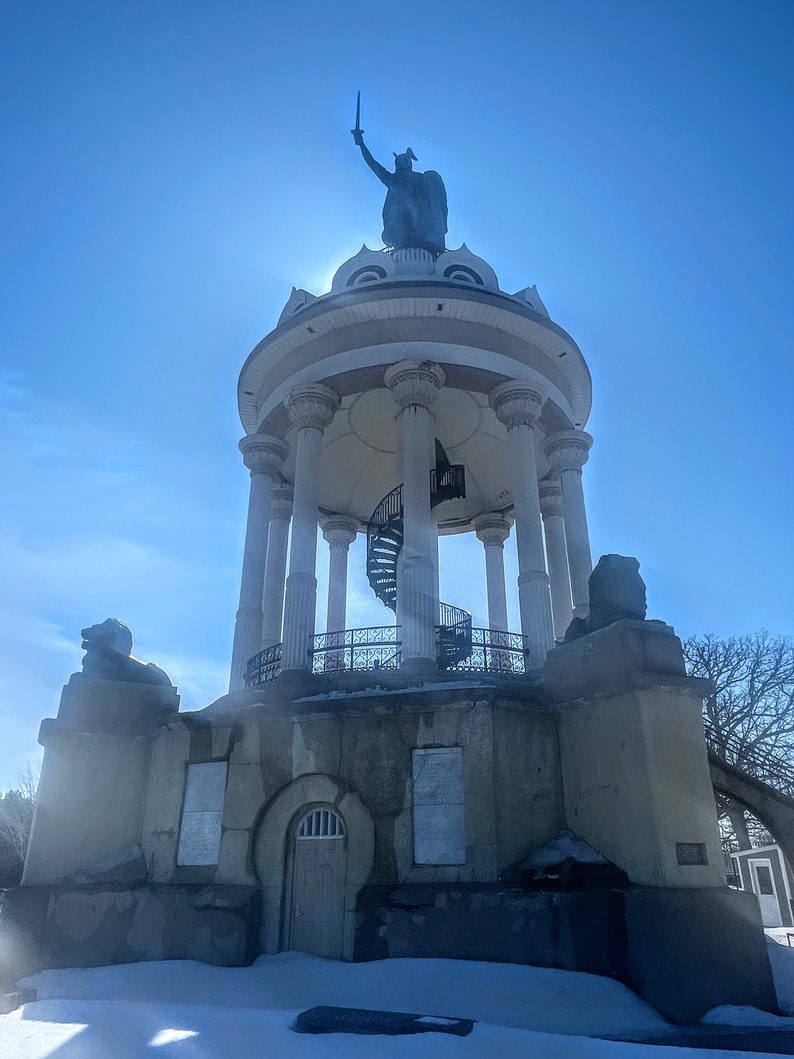
The largest monument is located in Detmold, Germany where you will find a 175-foot copper Hermann statue that has watched over the Teutoburg Forest since 1875, once thought to be the location of his battlefield triumph. A smaller replica of that statue sits on a hill overlooking the Hermann Heights neighborhood in New Ulm, Minnesota, constructed in 1897 under the orders of local Hermann Sons members. Elsewhere in the United States you can still find his likeness in a few halls once associated with the bygone national Hermann Sons organization; these halls are not connected to the Texas-based Hermann Sons organization.
Most Hermann likenesses seem to agree with the original depiction of the statue in Germany and liberties taken by that artist. Hermann is portrayed with a foot on an eagle, symbolizing one of three Roman legionary eagles lost in the battle and never recaptured. Other consistent features are his contrapposto stance with most of his weight on one foot, a sword in his right hand pointing heavenward, a large shield in his left hand, and an eagle on his helmet, this eagle symbolizing German heraldry. Hermann generally faces east, which is the direction from which the Roman legions attacked. Whether our Hermann faces east or west depends on whether you’re standing inside the ballroom or out on S. St. Mary’s street.
For 112 years, Hermann’s presence in our downtown landscape has served as a beautiful focal point, but its reference to historical events may not always be considered. We encourage you to take a new look at this curious window and consider both the artist and the subject in a new light.
For more information on the artist who created our window, see Stained Glass – Part 1.
by Jennifer Stanford | posted November 9, 2023
All rights reserved.
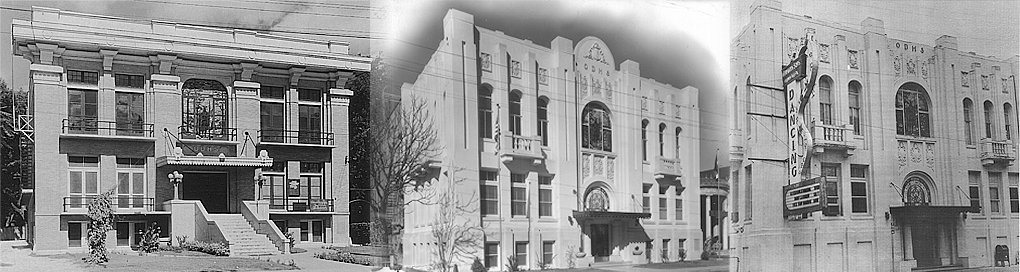
 Hermann Sons Hall
Leave a comment